
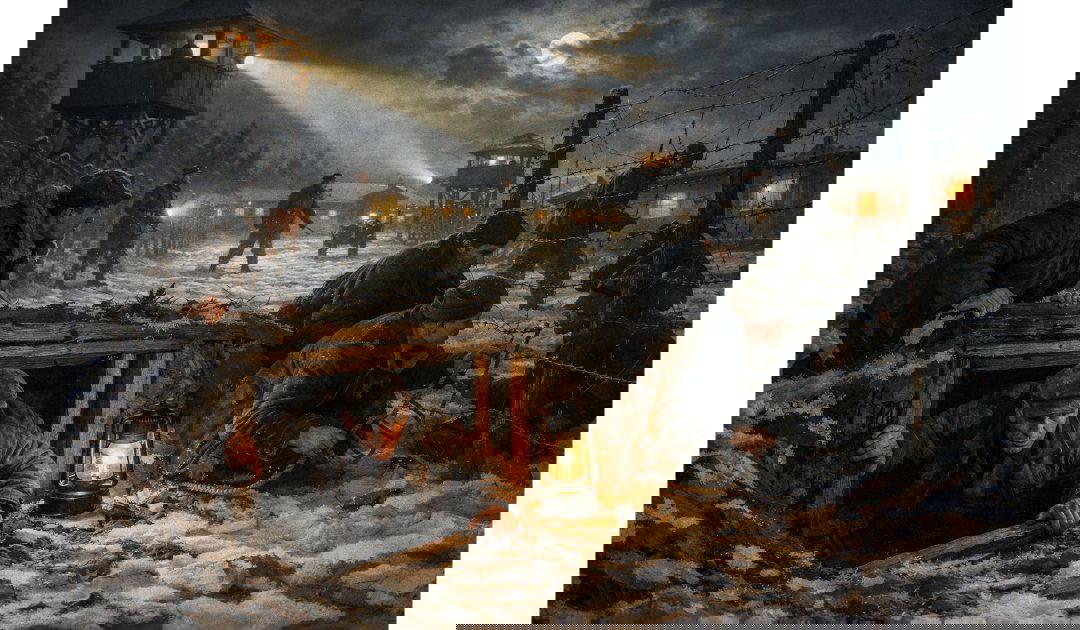
On the 24th of March, 1944, seventy-six allied prisoners of war escaped from Stalag Luft III in what has become known as The Great Escape. I wrote recently about Dachau and that when we were in Krakow we had decided not to visit Auschwitz. I did want to visit the site of Stalag Luft III but sadly it was a very long and expensive trip, so we didn’t.
The “Great Escape” from Stalag Luft III on the night of 24–25 March 1944 was one of the most audacious and meticulously planned prison breaks of the Second World War. Conceived and executed by Allied airmen held in a supposedly escape-proof German prisoner-of-war camp, it combined ingenuity, patience, engineering skill, and extraordinary courage. Though only three men ultimately reached freedom, the escape became a powerful symbol of resistance, ingenuity, and defiance.
Stalag Luft III was located near the town of Sagan in Lower Silesia (now Żagań, Poland). It was run by the Luftwaffe specifically to hold captured Allied air force officers. The camp had been designed with escape prevention in mind. The huts were raised above ground to prevent tunnelling. Microphones were buried in the soil to detect digging. The sandy yellow subsoil made any removed earth conspicuous. Guards patrolled constantly, and the camp was ringed by barbed wire and watchtowers.
Ironically, these measures brought together a population uniquely suited to defeat them. The inmates were aircrew officers: engineers, navigators, pilots, and men accustomed to problem-solving under pressure. Among them were experienced “escapers” who had tried before and learned from failure.
The mastermind was Squadron Leader Roger Bushell, a South African RAF officer known as “Big X.” Bushell had already escaped from camps twice before being recaptured. He envisioned not a small breakout, but a mass escape designed to overwhelm German resources and return as many trained officers as possible to the war.
The plan called for three tunnels—code-named Tom, Dick, and Harry—to be dug simultaneously from Hut 104 in the North Compound. If one were discovered, the others might survive. Ultimately Dick was abandoned as a storage tunnel after being partially exposed, Tom was discovered by the Germans in September 1943, and all hope rested on Harry.
The tunnel Harry was a masterpiece of improvised engineering. It was dug 30 feet (about 9 metres) below ground—far deeper than the Germans expected—reaching a length of over 330 feet (100 metres) to pass under the wire and reach the surrounding woods.
The challenges were immense:
- Ventilation: A hand-made air pump constructed from kit bags, wood, and tin cans forced air through a long duct system.
- Lighting: The prisoners tapped into the camp’s electrical wiring to run bulbs along the tunnel.
- Railway: A small trolley system made from bed boards ran on rails to move sand and supplies.
- Shoring: Thousands of bed boards were stolen to support the tunnel walls.
- Concealment: The biggest problem was disposing of the sand. The prisoners filled small cloth bags sewn into their trousers and gradually scattered the sand while walking around the compound—“penguin fashion”—so it blended into the soil.
All of this was done under the eyes of guards, during roll calls, searches, and inspections.
Escape required more than a tunnel. Forgers produced remarkably convincing travel documents, passes, and identity papers using improvised inks and stolen materials. Tailors turned blankets and uniforms into civilian clothes. Mapmakers recreated German railway maps from memory. Language experts coached escapers in accents and cover stories.
A committee selected 200 men considered best able to travel and evade capture. Ultimately, only 76 would make it out before the escape was discovered.
On the night of the 24th of March, 1944, the escape began. The men entered the tunnel one by one. A small hut trapdoor concealed the entrance.
But things did not go as planned. The tunnel emerged just short of the tree line, in open ground visible from a watchtower. Each man had to wait for clouds to obscure the moon before crawling out and running for cover. This caused long delays.
Around 4:55 a.m., a guard spotted the 77th man emerging and raised the alarm. Seventy-six had escaped.
What followed was the largest manhunt in German history. The Gestapo, police, soldiers, and civilians were mobilised. Roadblocks and searches spread across Germany and occupied Europe.
Within days, most of the escapers were recaptured. Only three men successfully reached safety:
- Flight Lieutenant Bram van der Stok (Netherlands) escaped to Spain.
- Flying Officer Per Bergsland (Norway) escaped to Sweden.
- Flight Lieutenant Jens Müller (Norway) also reached Sweden.
The rest were returned to custody.
Adolf Hitler was furious. He initially ordered all recaptured officers to be shot. After objections from senior officers concerned about reprisals against German POWs, the order was reduced—but still horrific. Fifty of the recaptured officers were handed to the Gestapo and executed in small groups under the pretext of being shot while “trying to escape.”
Among those murdered was Roger Bushell. The bodies were cremated, and the ashes returned to the camp in urns.
The killings were a clear violation of the Geneva Convention. After the war, the British War Crimes Investigation Unit painstakingly tracked down those responsible. Many Gestapo officers involved in the executions were tried and executed or imprisoned.
Within the camp, the escape had a powerful effect. Though the cost was terrible, morale soared. The prisoners had proved that the Germans were not infallible. They had forced the enemy to divert enormous resources to a manhunt and had embarrassed the Nazi regime internationally.
The Great Escape became legendary, particularly after Paul Brickhill, an Australian POW, wrote The Great Escape in 1950. The 1963 film adaptation cemented the story in popular imagination, though it fictionalised elements and emphasised American involvement (in reality, no Americans were among the escapers from Stalag Luft III at that time).
Today, the site of the camp is a memorial. The story is studied not just as an adventure but as an extraordinary example of collective organisation, leadership, and determination under captivity.
The Great Escape was not a military success in terms of numbers returned to duty. But as an act of defiance, ingenuity, and moral courage, it remains one of the most remarkable episodes of the Second World War.