
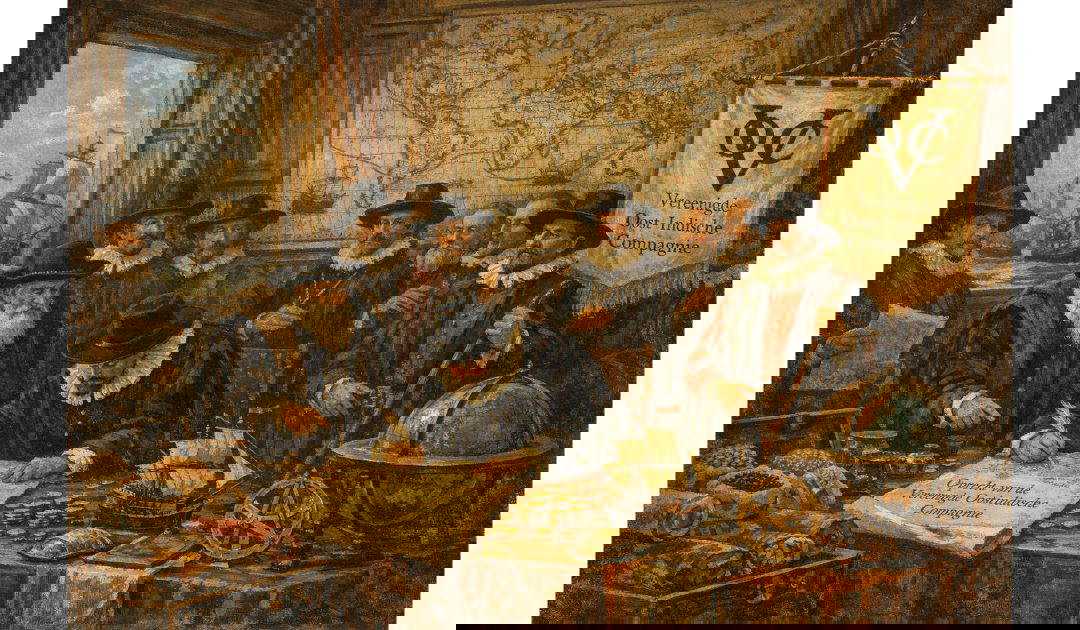
The Dutch East India Company, or the Vereenigde Oostindische Compagnie (VOC), was established on the 20th of March, 1602. It became the most powerful commercial organisation the world had yet seen. It was not merely a trading company, but a hybrid of corporation, navy, colonial administration and financial institution. For nearly two centuries it shaped global trade, European imperialism, and the economic development of the Dutch Republic, while leaving a complex and often troubling legacy across Asia.
Origins: Competition and Opportunity
By the late sixteenth century the Portuguese dominated the lucrative spice trade from the East Indies (modern Indonesia). Pepper, cloves, nutmeg and mace were worth extraordinary sums in Europe. Dutch merchants, newly independent from Spanish rule after the Dutch Revolt, were eager to break this monopoly. From the 1590s, several small Dutch trading ventures sent ships around the Cape of Good Hope to Asia. These expeditions were profitable but chaotic. Rival Dutch companies competed fiercely with one another, driving up costs and weakening their position against Iberian powers.
To solve this, the States-General of the Dutch Republic forced a merger of these competing ventures into a single organisation. In March 1602 theDutch East India Company was chartered and granted a 21-year monopoly on Dutch trade east of the Cape of Good Hope and west of the Straits of Magellan.
A Company with State Powers
What made the Dutch East India Company extraordinary was the scope of its authority. The charter allowed it to:
- Wage war
- Conclude treaties
- Build forts
- Maintain armies and fleets
- Govern overseas territories
- Mint coins
In effect, the Dutch government outsourced imperial expansion to a private corporation. The company was run by a board of directors known as the Heeren XVII (Lords Seventeen), representing chambers in Amsterdam, Zeeland, Rotterdam, Delft, Hoorn and Enkhuizen. Amsterdam dominated due to its financial weight. The Dutch East India Company also pioneered modern corporate finance: it issued permanent shares tradable on the Amsterdam Stock Exchange, making it arguably the world’s first multinational joint-stock corporation with publicly traded equity.
Establishing a Trading Empire
The Dutch East India Company’s objective was control of the spice trade at its source. This required more than buying spices; it required eliminating competition and controlling production.
In 1619 the company founded Batavia (modern Jakarta) on Java as its Asian headquarters. From there it projected power across the Indonesian archipelago. It drove out the Portuguese from key positions and fought bitterly with the English East India Company for influence, culminating in the 1623 Amboyna incident, where English traders were executed by the Dutch, effectively removing English competition from the spice islands for decades.
The Dutch East India Company imposed brutal monopolies on nutmeg and cloves in the Banda and Maluku islands. When local populations resisted selling exclusively to the Dutch, the company responded with force. In 1621, under Governor-General Jan Pieterszoon Coen, the Banda Islands were depopulated through massacre and deportation, and repopulated with enslaved labour to ensure compliance with VOC control.
A Vast Trading Network
Although spices were central, the Dutch East India Company’s trade became far broader. It operated an immense network linking:
- Japan (Dejima, where the Dutch were the only Europeans allowed to trade)
- China
- India (Coromandel Coast, Malabar)
- Ceylon (Sri Lanka)
- Persia
- The Cape Colony in South Africa (founded 1652 as a refreshment station)
- Southeast Asia and the Indonesian archipelago
The company traded textiles, tea, coffee, porcelain, silk, timber, precious metals, and slaves. It functioned as a giant intra-Asian trading machine as much as a Europe–Asia conduit.
Military and Naval Power
To protect its interests, the Dutch East India Company maintained fleets that rivalled national navies. It built forts from Ceylon to the Cape and waged wars against Asian states and European rivals. The conquest of Portuguese Ceylon in the mid-seventeenth century gave the Dutch East India Company control over cinnamon production. In Indonesia it intervened constantly in local politics, backing rulers who supported its monopoly.
This militarisation was expensive but essential to maintaining profits.
Wealth and Influence in the Dutch Golden Age
The Dutch East India Company was central to the Dutch Golden Age. Profits from Asian trade flowed into Amsterdam, financing art, science, banking and urban development. The Amsterdam stock exchange thrived on VOC shares. Investors from all levels of Dutch society participated, from wealthy regents to middle-class burghers.
At its height in the seventeenth century, the Dutch East India Company employed around 50,000 people worldwide and operated hundreds of ships. It has been called the richest corporation in history when adjusted for modern values.
Governance and Corruption
Administering such a vast empire proved difficult. Communication between Batavia and Amsterdam took many months. Company officials in Asia had enormous discretion and opportunities for private profit. Corruption was endemic. Many employees supplemented low official salaries with private trade, undermining the company’s monopoly.
The Dutch East India Company also struggled to govern diverse territories. It was designed as a trading enterprise, not a colonial state, yet it increasingly found itself ruling lands and peoples.
Decline in the Eighteenth Century
By the early eighteenth century, the spice trade was less profitable as supply increased and prices fell. Meanwhile, European tastes shifted towards tea, coffee and textiles, where the Dutch East India Company faced stronger competition.
Several factors contributed to decline:
- Mounting military and administrative costs
- Corruption and inefficiency
- Competition from the English East India Company
- Expensive wars in Java
- Heavy debts
The Fourth Anglo-Dutch War (1780–1784) was disastrous. British forces seized many Dutch East India Company possessions and trade routes. Financially crippled, the company was effectively bankrupt by the 1790s.
Dissolution and Legacy
In 1799 the Dutch government formally dissolved the Dutch East India Company. Its debts and possessions were taken over by the state, becoming the foundation of the Dutch East Indies colonial regime that lasted into the twentieth century.
The Dutch East India Company’s legacy is deeply mixed. It pioneered modern corporate structures, global finance, and long-distance trade networks. It connected continents in unprecedented ways and helped shape the modern global economy.
Yet it also pioneered corporate imperialism, monopolistic violence, forced labour, slavery, and the ruthless exploitation of indigenous populations. In places like Indonesia and Sri Lanka, memories of Dutch East India Company rule are associated with coercion and brutality.
Historical Significance
The Dutch East India Company stands at the intersection of capitalism, empire, and globalisation. It demonstrated how private capital, backed by state power, could dominate world trade. Many features of modern multinational corporations — shareholders, boards, global supply chains, and political influence — can be traced to its example.
For nearly two centuries, a company flag flew over forts, ships, and cities across half the globe. Few organisations before or since have wielded such sweeping economic, military and political power.