
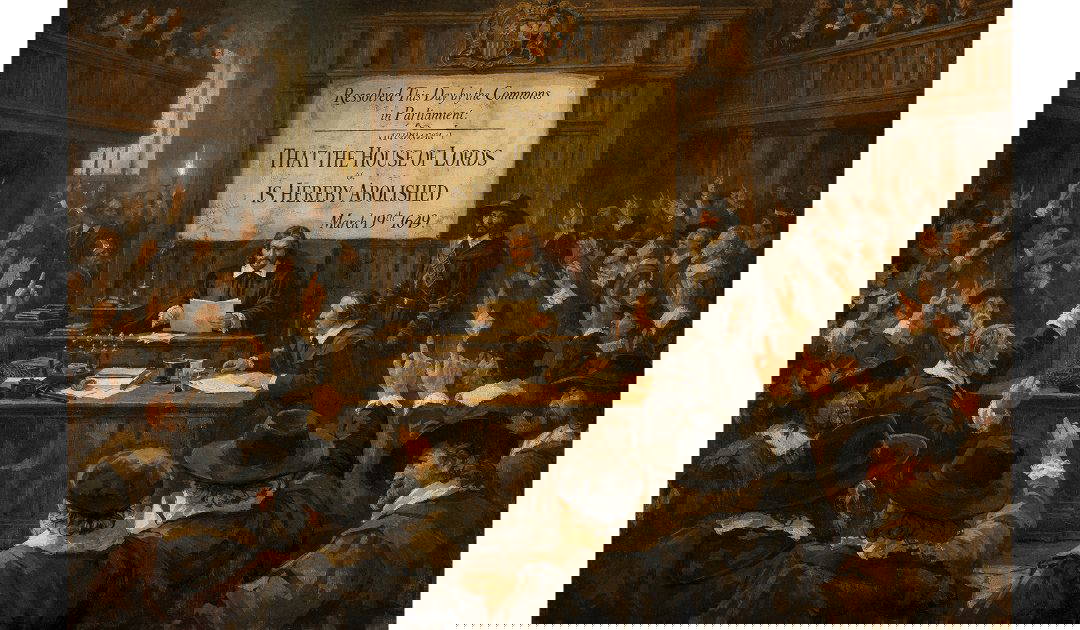
On the 19th of March, 1649, the English House of Commons passed one of the most extraordinary measures in the history of Parliament: “An Act for the Abolishing of the House of Lords.” The statute declared that the Lords were “useless and dangerous to the people of England,” and that legislative authority would henceforth reside in the Commons alone. This dramatic step was not an isolated outburst of revolutionary zeal but the culmination of years of civil war, constitutional crisis, and deep mistrust between Parliament, the monarchy, and the hereditary peerage.
Background: Civil War and Constitutional Breakdown
The roots of the act lay in the English Civil Wars (1642–1649). King Charles I’s long struggle with Parliament over taxation, religion, and royal prerogative had shattered traditional assumptions about governance. Many MPs came to believe that the King’s insistence on ruling without Parliament and his perceived sympathy for Catholicism posed a mortal threat to English liberties and Protestantism.
The House of Lords, composed largely of hereditary nobles and bishops, had traditionally served as a moderating chamber. However, during the wars many peers sided with the King. Others fled London, leaving the Lords depleted in numbers and political authority. By the later 1640s, the Lords were widely seen by radical parliamentarians as unreliable, aristocratic, and out of touch with the urgent needs of the nation.
The decisive turning point came in December 1648 with Pride’s Purge. Colonel Thomas Pride, acting on behalf of the New Model Army, forcibly excluded MPs who favoured negotiating with the King. What remained was the so-called Rump Parliament, dominated by those determined to bring Charles I to trial. The Lords refused to sanction the trial of the King, arguing that no court had authority over a reigning monarch. The Commons responded by asserting that “the people are, under God, the original of all just power,” and proceeded without the Lords’ consent
The execution of Charles I on the 30th of January, 1649, destroyed the old constitutional balance. With the monarchy gone and the Lords obstructing revolutionary legislation, many in the Commons and the Army leadership saw no reason to preserve the upper chamber.
Arguments for Abolition
Supporters of abolition argued from both practical and ideological grounds.
1. Obstructionism: The Lords had refused to cooperate with key measures, including the King’s trial. They were seen as an impediment to necessary reform at a moment of national crisis.
2. Aristocratic privilege: The very basis of the Lords’ authority—hereditary rank—clashed with emerging ideas about representation and popular sovereignty. Radical thinkers, influenced by Puritanism and political theorists, contended that power should not rest on birth but on the consent of the governed.
3. Alignment with the monarchy: Many peers had fought for Charles I. Even those who remained were suspected of royalist sympathies. In the new republic, such loyalties were considered dangerous.
4. Simplicity and efficiency: A single legislative chamber, it was argued, would be more efficient and better able to enact the sweeping reforms needed after years of war.
The Act itself stated bluntly that the House of Lords was “useless and dangerous to the people of England.” This language reflected not only frustration but a genuine belief among many that the traditional aristocracy threatened the new political order.
Arguments Against Abolition
Opposition to the measure did exist, though it was muted by the political climate and the Army’s dominance.
1. Constitutional balance: Traditionally, the Lords acted as a check on hasty legislation from the Commons. Removing them risked concentrating too much power in one body.
2. Stability and tradition: England’s political system had evolved over centuries. Abolishing a fundamental institution risked plunging the nation into uncharted and potentially unstable territory.
3. Fear of radicalism: Some feared that without the moderating influence of the Lords, the Commons might fall under the sway of radical groups such as the Levellers, who advocated sweeping democratic reforms.
4. Legitimacy: Critics questioned whether a purged Parliament, backed by the Army, had the moral authority to dismantle ancient institutions.
Yet in March 1649, such objections carried little weight. The political reality was that the Rump Parliament, supported by the New Model Army and figures like Oliver Cromwell, held effective power.
The Act and Its Immediate Consequences
The Act passed swiftly. The House of Lords ceased to function, and England became, in theory, a unicameral republic. Soon another act had abolished the monarchy itself. England was declared a Commonwealth.
In practice, however, power did not reside purely with the Commons. The Army’s influence was pervasive. Many MPs were closely aligned with military leaders, and Cromwell’s authority loomed large. The abolition of the Lords removed a traditional check but did not create a fully democratic system; instead, it cleared the way for rule by a revolutionary elite.
What Happened Afterwards
The experiment in republican government proved unstable. The Rump Parliament struggled to enact reforms and became increasingly unpopular. In 1653 Cromwell dissolved it by force, later ruling as Lord Protector under a written constitution, the Instrument of Government. Although the Lords had been abolished, Cromwell eventually created a new upper chamber, sometimes called the “Other House,” composed of appointed members rather than hereditary peers—an implicit acknowledgment that some form of second chamber was useful.
After Cromwell’s death in 1658, political chaos followed. In 1660 the monarchy was restored under Charles II. With it came the restoration of the House of Lords. The revolutionary abolition of 1649 was reversed, and England returned to its traditional bicameral Parliament.
Yet the events of 1649 had lasting consequences. The assertion that the Commons represented the sovereign will of the people left a deep mark on political thought. The Lords, though restored, never fully regained the unquestioned authority they had once held. Over the following centuries their power would be gradually reduced, notably by the Parliament Acts of 1911 and 1949.
Significance
The abolition of the House of Lords in March 1649 was as a remarkable moment when England briefly rejected aristocratic governance in favour of a radical experiment in republicanism. It revealed the depth of distrust toward hereditary privilege and highlighted the growing belief that political authority should rest with representatives of the people.
Although the measure lasted little more than a decade, it foreshadowed later constitutional developments and debates about the role of the upper chamber. It also demonstrated how, in times of crisis, longstanding institutions can be swept aside with startling speed.
In the charged atmosphere following civil war and regicide, the Commons’ declaration that the Lords were “useless and dangerous” captured the revolutionary spirit of the age—a moment when England stood on the brink of a new political order, uncertain, experimental, and profoundly transformative.