
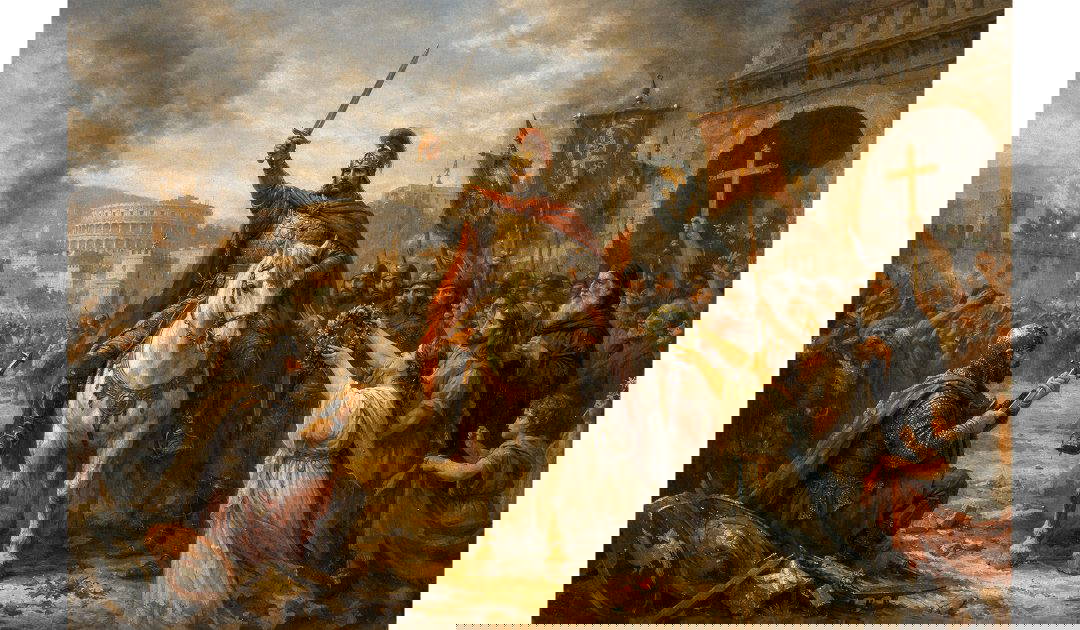
On the 12th of March, 538CE, the Byzantine general Belisarius forced Vitiges king of the Ostrogoths to end his siege of Rome and retreat to Ravenna. Flavius Belisarius (c. 500–565 CE) was the most brilliant general of the Byzantine Emperor Justinian I and one of the last commanders in history who could plausibly be compared with the great captains of antiquity. In an age when the Western Roman Empire had fallen and much of its former territory was ruled by Germanic kingdoms, Belisarius became the instrument through which Justinian briefly restored Roman power across the Mediterranean. His campaigns against Persians, Vandals, and Ostrogoths were marked by daring, adaptability, and an ability to win victories with limited resources. Yet his life was also shaped by court intrigue, imperial suspicion, and a reputation for loyalty that endured even when he fell from favour.
Belisarius was probably born in Thrace or Illyricum, regions that supplied many soldiers to the imperial army. He rose to prominence not through noble birth but through talent and the patronage of Justinian, who was then heir to the throne. As a young officer he served on the eastern frontier against the Sasanian Persian Empire, Rome’s most formidable rival. There he demonstrated a rare grasp of both defensive and offensive warfare. At the Battle of Dara in 530, Belisarius used careful field fortifications, disciplined infantry, and well-timed cavalry charges to defeat a larger Persian force. Although he later suffered a setback at Callinicum, his reputation for ingenuity and steadiness under pressure was established.
His first great independent command came in 533, when Justinian entrusted him with an ambitious expedition to North Africa to overthrow the Vandal Kingdom. With a relatively small army of perhaps 15,000 men, Belisarius sailed from Constantinople and landed near Carthage. In a swift and brilliantly executed campaign, he defeated the Vandals at Ad Decimum and Tricamarum, captured Carthage, and effectively destroyed the Vandal state within months. The speed of the conquest astonished contemporaries. North Africa, one of the richest provinces of the old Western Empire, was restored to imperial rule. Belisarius returned to Constantinople in triumph, and granted the rare honour of a Roman-style triumphal procession.
Almost immediately he was sent to Italy to confront the Ostrogoths, who ruled there under King Theodahad and later Vitiges. Beginning in 535, Belisarius advanced methodically up the peninsula. He took Sicily with little resistance, crossed to the mainland, and captured Naples after a difficult siege. In December 536 he entered Rome, which he would defend with legendary tenacity. In 537–538 Vitiges besieged the city with a far larger army. Belisarius, short of supplies and reinforcements, relied on bold sorties, engineering skill, and psychological warfare to hold the walls. The siege ended in failure for the Goths, and Belisarius emerged as the saviour of Rome.
His campaign in Italy, however, was complicated by politics. Justinian, wary of giving too much power to any general, divided command and withheld reinforcements. Rival officers and court factions undermined Belisarius’s authority. Nevertheless, he pushed north and in 540 captured Ravenna, the Gothic capital. In a remarkable episode, the Goths, desperate for stability, offered to proclaim Belisarius Western Emperor. He pretended to accept in order to enter the city peacefully, then declared Ravenna for Justinian instead. This act demonstrated both his cunning and his unshakeable loyalty.
Despite these achievements, Belisarius’s position at court was never secure. Justinian and the Empress Theodora were prone to suspicion, and Belisarius’s fame made him a potential threat. He was recalled from Italy before the Gothic War was fully resolved, and much of his earlier work was undone as the conflict dragged on for years under other commanders. He was later sent back to Italy, but with insufficient troops to achieve decisive results.
Belisarius also returned to the Persian front, where he continued to show defensive skill, though without the spectacular victories of earlier years. In 559, late in life, he was called upon once more when a Hunnic tribe, the Kutrigurs, threatened Constantinople. With a small, hastily assembled force, he repelled them, once again saving the empire in a moment of crisis.
Legend holds that Belisarius was later accused of conspiracy, blinded, and reduced to begging in the streets, crying “Give a coin to Belisarius.” This story, popular in later centuries and immortalised in art and literature, is almost certainly untrue. Historical evidence suggests he was disgraced briefly but restored to favour before his death in 565, the same year as Justinian.
Belisarius’s greatness lay not only in his victories but in his methods. He excelled at using mobility, discipline, and intelligence rather than brute force. He commanded a diverse army of Romans, Isaurians, Thracians, Huns, and others, forging them into an effective fighting force. He was skilled in siegecraft, logistics, and the management of morale. Above all, he remained steadfastly loyal to Justinian, even when mistrusted or sidelined.
In many ways, Belisarius was the last Roman general in the classical mould: adaptable, resourceful, and capable of commanding across vast theatres of war. His campaigns briefly reunited much of the Mediterranean under imperial rule and preserved the illusion that Rome’s greatness could be restored. Though Justinian’s reconquests proved difficult to hold in the long term, the memory of Belisarius endured as a symbol of military genius and personal fidelity in a turbulent age.