
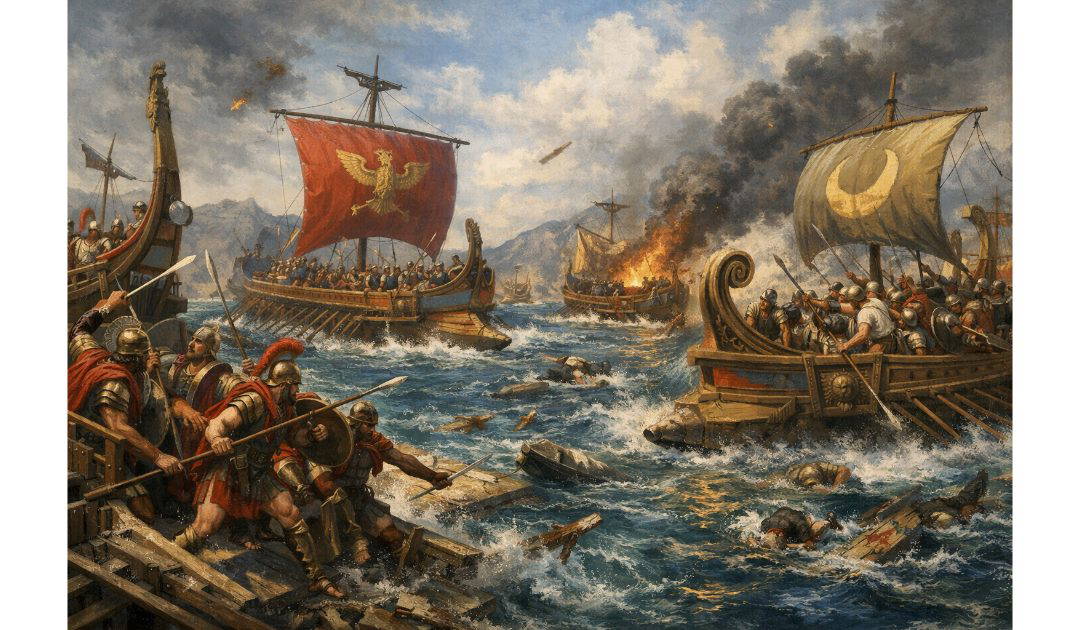
On the 10th of March, 241 B.C. the Battle of Aegates was fought, and won by the Romans, bringing the First Punic War, between Rome and Carthage, to a close after nearly twenty-three years of exhausting conflict. Taking place off the western coast of Sicily near the Aegates (modern Egadi) Islands, the battle demonstrated how Rome, a power that had begun the war with little naval experience, had transformed itself into a formidable maritime force capable of defeating the greatest sea power of the western Mediterranean.
By 241 B.C., both Rome and Carthage were financially and physically drained. The First Punic War, which had begun in 264 B.C. over control of Sicily, had dragged on through countless land battles, sieges, and earlier naval engagements. Carthage, with its long maritime tradition, had initially dominated the sea. Rome, however, had adapted quickly, building fleets and developing innovative tactics such as the corvus, a boarding bridge that allowed Roman soldiers to fight naval battles as if they were land engagements. Over time, Rome learned the art of seamanship itself.
The strategic situation in the final years of the war centered on western Sicily. Carthaginian forces still held strong positions at Lilybaeum (modern Marsala) and Drepana (Trapani), supplied by sea from North Africa. Rome had attempted to blockade these ports for years, but earlier Roman fleets had been wrecked by storms or defeated in battle. By the late 240s B.C., Carthage relied heavily on its ability to resupply these garrisons by sea, as its land forces in Sicily were increasingly isolated.
Rome, nearly bankrupt from the long war, could not fund another fleet through the state treasury. In a remarkable demonstration of private patriotism, wealthy Roman citizens financed the construction of a new fleet of about 200 quinqueremes. These ships were built based on a captured Carthaginian model, making them lighter, faster, and more maneuverable than earlier Roman vessels. Importantly, the Romans abandoned the heavy corvus boarding device, which had made ships unstable in rough seas, and instead trained their crews in traditional naval ramming tactics.
The Roman fleet was placed under the command of the consul Gaius Lutatius Catulus, with his subordinate Quintus Valerius Falto. Catulus spent months drilling his crews, ensuring they were well-trained and disciplined. He also established a tight blockade of the Carthaginian-held ports, preventing supplies from reaching the garrisons in Sicily.
Carthage, recognizing the desperate situation of its forces, assembled a relief fleet under the command of Hanno. This fleet carried large quantities of grain and supplies intended for the besieged troops. However, because the ships were heavily laden with cargo and the crews were less well-trained than their Roman counterparts, the Carthaginian fleet was at a disadvantage from the outset.
On the morning of the 10th of March, the Carthaginian fleet approached Sicily, attempting to take advantage of favorable winds to slip past the Roman blockade. Catulus, observing the enemy movement from high ground on the island of Aegusa, seized the opportunity. Despite rough seas and strong winds, he ordered his fleet to put to sea and intercept the Carthaginians before they could reach port.
The Roman ships, lighter and manned by well-trained crews, were able to maneuver effectively in the difficult conditions. In contrast, the Carthaginian vessels, burdened with supplies, struggled to respond. The battle quickly turned into a brutal contest of ramming and boarding. Roman ships smashed into their opponents, stove in hulls, and disabled oars. Many Carthaginian vessels were captured rather than sunk, as Roman marines boarded and overwhelmed their crews.
Ancient sources, particularly Polybius, report that around 50 Carthaginian ships were sunk and about 70 captured, with thousands of men taken prisoner. The rest of the fleet fled. The Roman losses were comparatively light.
The defeat was catastrophic for Carthage. Without naval supremacy, it was impossible to resupply or reinforce its troops in Sicily. The Carthaginian government, already financially strained, had no choice but to seek peace. Hamilcar Barca, the Carthaginian commander in Sicily and father of Hannibal, was authorized to negotiate terms.
The resulting peace treaty marked a turning point in Mediterranean history. Carthage agreed to evacuate Sicily, which became Rome’s first overseas province. Carthage also paid a heavy indemnity and later lost Sardinia and Corsica to Rome. The balance of power in the western Mediterranean shifted decisively in Rome’s favor.
The Battle of the Aegates Islands was significant not only for ending the war but for what it revealed about Rome’s adaptability. In a single generation, Rome had evolved from a land-based republic with minimal naval tradition into a dominant maritime power capable of defeating Carthage at sea. The battle also demonstrated the importance of logistics, training, and ship design over mere numerical strength.
For Carthage, the defeat was humiliating but not final. The resentment over the harsh terms of peace and the loss of territories would contribute to the outbreak of the Second Punic War a generation later, when Hannibal Barca would carry the fight to Italy itself.
Thus, the Battle of the Aegates Islands stands as a decisive moment in ancient history. It ended one of the longest wars of antiquity, marked the beginning of Roman overseas expansion, and set the stage for Rome’s eventual dominance of the Mediterranean world.