
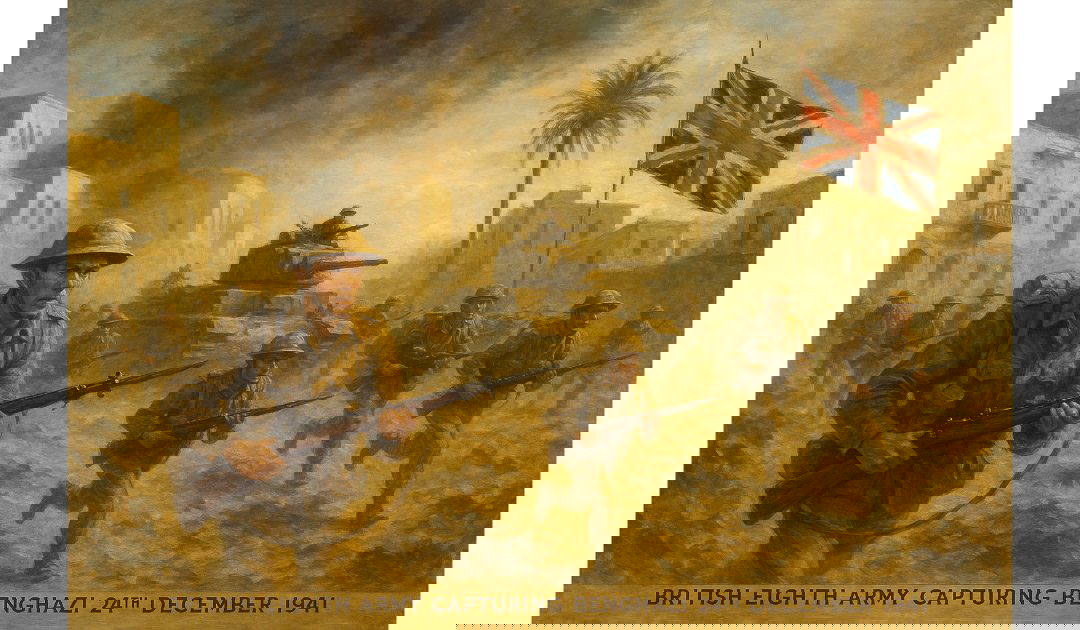
On the 22nd of January, 1941, Tobruk was captured from the Italians by British and Commonwealth forces during the Western Desert campaign of World War Two. Although Tobruk features on my father’s battle honours, that was the 1942 battle in which we retook it from the Germans.
The port city of Tobruk, on Libya’s eastern Mediterranean coast, became one of the most contested and symbolically charged battlegrounds of the North African campaign in the Second World War. Its importance lay in its deep-water harbour, which offered a vital logistical base for any army operating along the barren Cyrenaican coast. The battles for Tobruk began with Operation Compass in late 1940 and evolved into a prolonged struggle that encapsulated the wider fortunes of the desert war.
Operation Compass was launched by British and Commonwealth forces in December 1940 as a limited offensive against the Italian Tenth Army, which had invaded Egypt from Libya earlier that year. Under the command of General Sir Archibald Wavell, the Western Desert Force—composed largely of British, Australian, and Indian units—quickly exceeded its initial objectives. Using mobility, surprise, and superior leadership, the British shattered Italian defensive positions at Sidi Barrani and drove westwards into Cyrenaica. By January 1941 the Italian army was in full retreat, its morale broken and its formations collapsing.
Tobruk fell on the 22nd of January, 1941, after a short but decisive assault by Australian troops of the 6th Division. The Italians had heavily fortified the port, but their resistance was uneven and poorly coordinated. Thousands of Italian soldiers were captured, along with large quantities of supplies, artillery, and vehicles. The capture of Tobruk was a major triumph for the British, providing them with a forward supply base and marking the near-destruction of Italy’s military presence in eastern Libya. Within weeks, the remnants of the Italian Tenth Army were annihilated at Beda Fomm.
This dramatic success, however, proved short-lived. In March 1941 German forces arrived in North Africa under the command of General Erwin Rommel, forming the Afrika Korps. Although initially intended as a defensive mission, Rommel quickly went on the offensive, exploiting British overextension and thinly held positions. In a rapid and audacious advance, Axis forces pushed the British back across Cyrenaica. By April 1941 Tobruk was surrounded, beginning one of the most famous sieges of the war.
The Siege of Tobruk lasted from April to November 1941. The garrison, composed mainly of Australian troops later reinforced by British, Polish, and other Commonwealth units, held the port against repeated German and Italian attacks. Dubbed the “Rats of Tobruk” by Axis propaganda—a nickname the defenders adopted with pride—the garrison endured constant artillery bombardment, air attacks, and ground assaults. Tobruk’s defence was strategically vital: by holding the port, the Allies denied Rommel its use as a supply base and forced his armies to rely on long, vulnerable supply lines back to Tripoli.
Several attempts were made to relieve Tobruk. Operation Brevity and Operation Battleaxe in mid-1941 failed, exposing weaknesses in British armour and command. It was not until Operation Crusader in November 1941 that the siege was finally lifted. After heavy fighting across the desert, British Eighth Army forces forced Rommel to withdraw, and Tobruk was relieved after 241 days under siege. This marked a significant Allied success and restored some confidence after earlier reverses.
Yet Tobruk’s ordeal was not over. In early 1942 Rommel again advanced eastwards following British setbacks at Gazala. In a dramatic reversal, Axis forces captured Tobruk on the 21st of June, 1942, taking over 30,000 Allied prisoners in one of Britain’s worst defeats of the war. The loss shocked the British public and political leadership, leading to Winston Churchill facing a vote of no confidence in Parliament. Tobruk’s fall also provided the Axis with a critical logistical prize, enabling Rommel’s advance into Egypt and towards El Alamein.
The final chapter came later that year. After the decisive Allied victory at the Second Battle of El Alamein in October–November 1942, Axis forces retreated westwards. Tobruk was recaptured by Allied troops in November 1942 during the pursuit, this time with little resistance. From then on, the Axis would never regain the initiative in North Africa.