
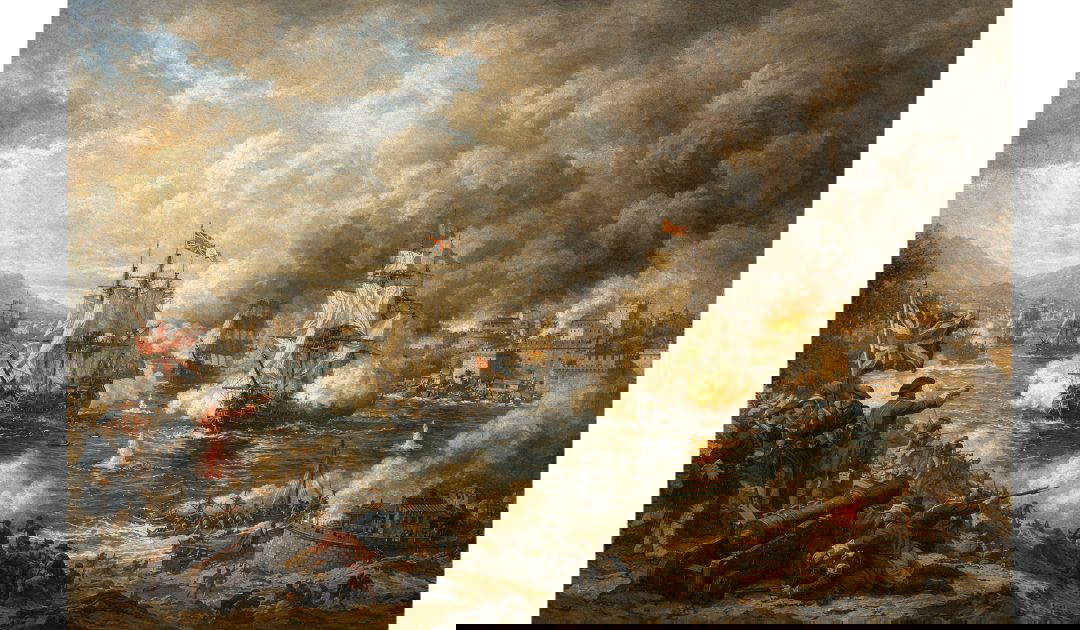
The Battle of Toulon began on the 22nd of February, 1744, as a result of which several Royal Navy captains were court-martialed, and the Articles of War were amended. It was a major naval engagement of the War of the Austrian Succession and one of the most controversial episodes in Royal Navy history. Although the battle itself was tactically indecisive, its aftermath proved explosive, leading to an unprecedented wave of courts-martial among British naval officers and exposing deep flaws in command, doctrine, and political expectations.
Background and strategic context
By 1744 Britain was at war with France, while Spain was allied with France against Austrian and British interests. A combined Franco-Spanish fleet lay blockaded in the Mediterranean port of Toulon by a British fleet under Admiral Thomas Mathews, with Rear-Admiral Richard Lestock commanding the rear division. The British objective was clear: prevent the allied fleet from leaving port and, if possible, bring it to battle and destroy it. Politically, the Admiralty and the government expected a decisive victory that would demonstrate British naval dominance.
The blockade had already been strained by poor coordination between Mathews and Lestock, whose personal hostility toward one another was well known. This poisonous relationship would prove disastrous once battle was joined.
The battle itself
When the Franco-Spanish fleet sailed from Toulon in February 1744, Mathews moved to engage. The British fleet was organised in the traditional line of battle, divided into three squadrons: van, centre, and rear. However, light winds, confusion of signals, and contradictory interpretations of standing orders quickly disrupted British cohesion.
Mathews, commanding the centre, believed that delay would allow the enemy to escape. Acting decisively—but controversially—he broke the line and ordered a general attack on the enemy’s centre. His flagship, HMS Namur, engaged closely with Spanish ships, and heavy fighting followed. Meanwhile, several British captains, especially in the rear division under Lestock, failed to close with the enemy. Lestock himself maintained the line strictly, arguing that Mathews had not made his intentions clear through proper signals.
The result was a chaotic engagement. Some British ships fought fiercely at close quarters; others barely fired a shot. The Franco-Spanish fleet, though battered, managed to withdraw in good order and eventually reached safety. Strategically, Britain failed to achieve its aim of destroying the enemy fleet, and the battle was widely seen as a missed opportunity.
Why the aftermath mattered more than the battle
In purely naval terms, Toulon was not a crushing defeat. British losses were relatively modest, and the enemy suffered considerable damage. However, public and political expectations in Britain were very high. The Royal Navy was viewed as the ultimate guarantor of national security, and any failure to secure a clear victory was treated as unacceptable.
Admiral Mathews himself was furious at what he perceived as cowardice and disobedience among his subordinates. He accused several captains—and especially Lestock—of deliberately failing to support him. Lestock, in turn, blamed Mathews for abandoning the line of battle and issuing unclear and improper signals. The dispute escalated into a full-scale scandal.
The courts-martial
The scale of the disciplinary response was extraordinary. Admiral Mathews was recalled and court-martialed, as was Rear-Admiral Lestock. In addition, a large number of captains who had commanded ships during the engagement were tried. Some were accused of not doing their utmost to engage the enemy, while others were charged with failing to follow signals or maintain their station.
Several factors explain why so many officers faced trial:
- Rigid naval doctrine
At the time, Royal Navy fighting instructions placed enormous emphasis on maintaining the line of battle and obeying signals precisely. Any deviation—whether excessive caution or excessive initiative—could be interpreted as misconduct. Toulon exposed how inflexible doctrine clashed with the realities of battle, but the courts largely judged officers by the rulebook rather than circumstance. - Political pressure
The government and Admiralty needed scapegoats. A vague “indecisive action” was politically damaging, so responsibility had to be assigned. Courts-martial provided a visible demonstration that failure would not be tolerated. - Personal rivalries
The open hostility between Mathews and Lestock poisoned proceedings. Each side gathered allies and testimony to defend themselves and implicate others, dragging more captains into the legal maelstrom. - The Articles of War
The Articles of War required officers to “do their utmost” against the enemy, a phrase interpreted with brutal severity. Failure to engage closely could be treated as a capital offence, regardless of tactical justification.
Consequences and legacy
The verdicts were mixed but controversial. Mathews was dismissed from the service, effectively ending his career. Lestock, despite widespread criticism, was acquitted, largely because he could argue—correctly—that he had obeyed signals as given. Several captains were cashiered or reprimanded, while others were acquitted after lengthy proceedings.
The Battle of Toulon and its aftermath left a lasting mark on the Royal Navy. It exposed the dangers of over-rigid obedience and the inadequacy of signalling systems, lessons that would resurface dramatically in later cases, most famously the execution of Admiral John Byng after the loss of Minorca in 1756. Toulon became a cautionary tale: not of cowardice in battle, but of how confusion, personality clashes, and inflexible discipline could turn an imperfect action into a career-destroying catastrophe for Britain’s naval officers.