
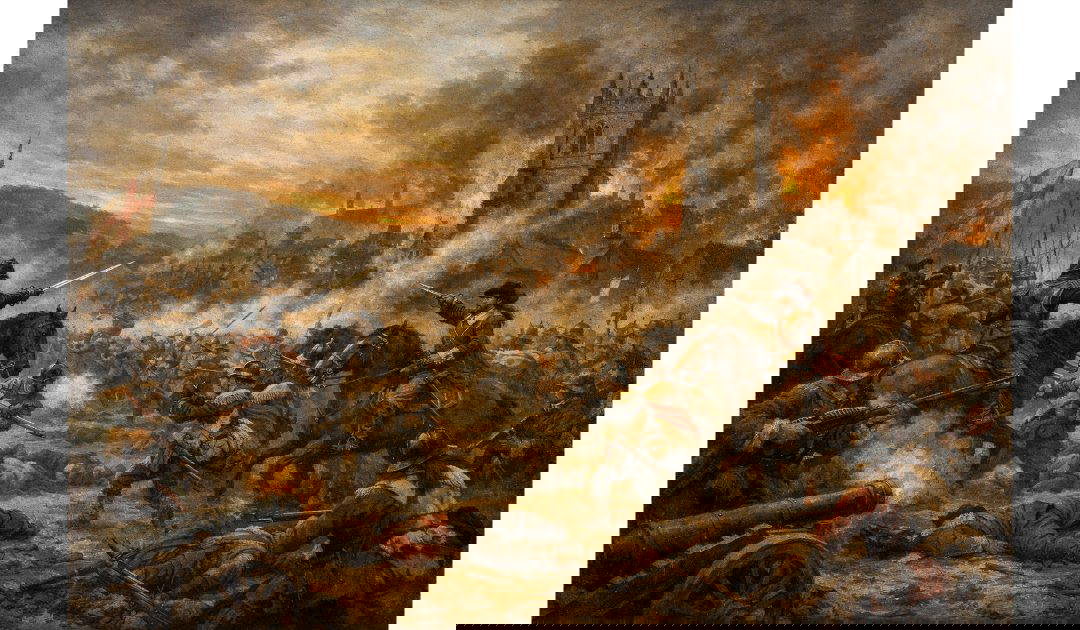
The Battle of Torrington was fought on the 16th of February, 1646. I recall that Admiral Sir John Byng was Viscount Torrington, but Torrington was a land battle in Devon. It was one of the last major engagements of the First English Civil War and marked the effective collapse of organised Royalist resistance in the West Country. Though small in scale compared to earlier battles such as Naseby or Marston Moor, Torrington was decisive in its consequences, sealing Parliament’s control of Devon and Cornwall and hastening the end of the war.
By early 1646 the Royalist cause was in steep decline. King Charles I had lost his main field army the previous summer at Naseby, and Parliament’s New Model Army had proved itself a disciplined and formidable force. However, in the West Country a stubborn Royalist army under Lord George Goring continued to resist. Goring’s troops, though weakened by desertion and poor discipline, still posed a threat and were notorious for their heavy-handed treatment of the local population, which increasingly turned opinion against them.
Opposing Goring was Sir Thomas Fairfax, commander-in-chief of Parliament’s forces. Fairfax had been systematically reducing Royalist strongholds in the southwest, capturing Exeter and pressing hard into Devon. By February, Goring was retreating northward, attempting to regroup and perhaps escape into Wales. The small market town of Great Torrington, set on a ridge above the River Torridge, became the final stage for this pursuit.
The Royalist army at Torrington numbered roughly 3,000–4,000 men, a mixture of cavalry and foot soldiers, many of them exhausted, poorly supplied, and demoralised. Fairfax’s Parliamentary force was larger—around 8,000–10,000 men—better equipped, and highly motivated by recent successes. Crucially, Fairfax also enjoyed superior intelligence and coordination. Goring believed Torrington to be a defensible position and chose to make a stand there, hoping to delay Fairfax long enough to withdraw his army. The town’s narrow streets, stone buildings, and surrounding hedged fields seemed suitable for a defensive action, especially against a frontal assault.
Fairfax attacked at night, an unusual but deliberate choice designed to surprise the Royalists and prevent an organised withdrawal. Parliamentarian troops advanced cautiously toward the town, encountering Royalist outposts and skirmishers in the darkness. Fighting soon spread into Torrington’s streets, where confusion reigned amid smoke, musket fire, and shouted commands.
The battle turned decisively when a Royalist powder magazine, stored in St Michael and All Angels Church, was accidentally ignited—possibly by a stray musket shot or artillery fire. The resulting explosion was catastrophic. The church was largely destroyed, nearby buildings collapsed, and a firestorm swept through the centre of the town. Hundreds of Royalist soldiers were killed or wounded instantly, while others were thrown into panic by the sudden inferno. The explosion broke Royalist resistance. With their lines shattered and the town ablaze, Goring’s men fled in disorder. Fairfax’s cavalry pursued them relentlessly across the Torridge valley, cutting down fugitives and capturing large numbers. By dawn, the battle was effectively over.
Royalist losses were severe: around 1,000 men killed, wounded, or captured, including many experienced soldiers the king could ill afford to lose. Parliamentarian casualties were comparatively light. Torrington itself was devastated, with much of the town burned or ruined by the explosion and ensuing fires. Goring managed to escape with a small remnant of his cavalry, but his army was finished as a fighting force. Within weeks, remaining Royalist garrisons in the West Country surrendered one by one, including Dartmouth, Barnstaple, and Pendennis Castle later in the year.
The Battle of Torrington effectively ended the Royalist war effort in southwest England. With the West Country lost, King Charles I was left without any substantial regional base from which to continue the conflict. Only scattered garrisons and minor forces remained elsewhere, and these too would soon capitulate.
Strategically, Torrington demonstrated the maturity and confidence of the New Model Army, particularly its ability to conduct complex operations such as night attacks. It also illustrated how logistics, morale, and public support had become decisive factors: Goring’s army collapsed not just because it was defeated tactically, but because it was already exhausted, unpopular, and short of supplies. Politically, the battle hastened the end of the First Civil War. Just three months later, in May 1646, Charles I surrendered to the Scottish army at Newark, effectively conceding defeat.