
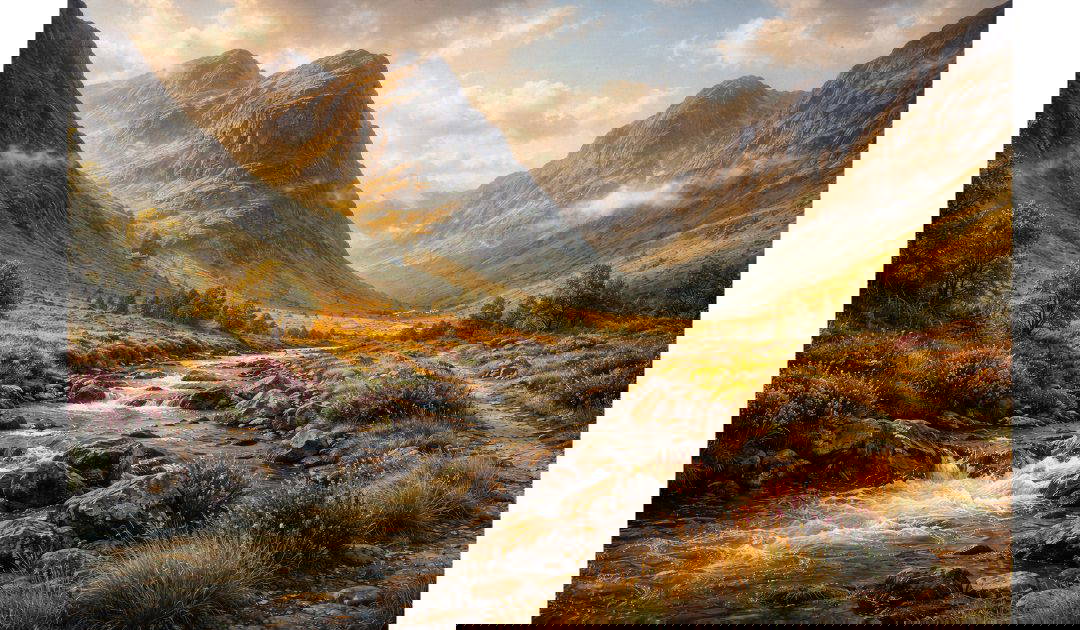
On the 13th of February, 1692, the MacDonald Clan were massacred in Glen Coe. Glen Coe is one of Scotland’s most dramatic and evocative landscapes, a place where raw natural beauty and dark human history are inseparably intertwined. Situated in the western Highlands, south of Fort William, the glen cuts a deep, brooding corridor through towering mountains whose steep sides and shifting light have made it an emblem of Highland grandeur. To many visitors it is a place of awe and melancholy; to historians it is a landscape shaped as much by violence and politics as by ice and fire.
Geologically, Glen Coe is the remnant of a vast volcanic caldera formed around 420 million years ago during the Silurian period. The mountains that hem in the glen—Buachaille Etive Mòr, Bidean nam Bian, and the serrated Aonach Eagach ridge—are the eroded roots of this ancient volcano. Later, during the Ice Ages, glaciers scoured the valley into its present U-shaped form, carving steep sides and a broad floor through which the River Coe now runs. This combination of volcanic drama and glacial shaping gives Glen Coe its uniquely rugged character.
Long before its tragic fame, Glen Coe was part of the Gaelic-speaking world of the western Highlands. It lay within the territory of Clan Donald of Glencoe, a branch of the powerful Clan Donald or MacDonald, Lords of the Isles. The MacDonalds of Glencoe lived by a mixture of cattle farming, hunting, and the customary Highland practices of the time, including raiding. Their world was governed by clan loyalty, kinship, and an ancient code of hospitality that would later make their fate especially shocking.
The glen entered British history indelibly with the Massacre of Glencoe in February 1692. This event occurred in the aftermath of the Glorious Revolution of 1688, which had deposed the Catholic King James VII of Scotland (James II of England) and replaced him with the Protestant monarchs William III and Mary II. In the Highlands, many clans remained loyal to the exiled James, becoming known as Jacobites. In an effort to pacify the region, William’s government required Highland chiefs to swear an oath of allegiance by the 1st of January, 1692.
Alasdair MacIain, chief of the MacDonalds of Glencoe, attempted to comply but was delayed by circumstances beyond his control, including severe winter weather and bureaucratic obstruction. Although he eventually took the oath, it was deemed late. This technical failure provided the government—particularly figures such as John Dalrymple, Secretary of State for Scotland—with a pretext to make an example of the clan.
What followed was a calculated act of state violence cloaked in betrayal. Government troops, many of them from the Campbell clan, were billeted among the MacDonalds for nearly two weeks, enjoying their hospitality. In the early hours of the 13th of February 1692, they received orders to kill their hosts. Thirty-eight MacDonalds were murdered outright, including MacIain himself; many more died later from exposure as they fled into the frozen mountains. The outrage was compounded not only by the killing of civilians but by the violation of Highland codes of honour and hospitality.
News of the massacre reverberated across Scotland and Europe, becoming a symbol of governmental cruelty and moral corruption. Although an official inquiry later condemned the killings, no one was seriously punished, and Glen Coe became a byword for treachery. For the Jacobite cause, the massacre hardened resentment and fed the cycle of rebellion that would erupt again in the uprisings of 1715 and 1745.
In the centuries that followed, Glen Coe gradually emptied. The Highland Clearances of the late eighteenth and nineteenth centuries displaced many remaining inhabitants, replacing people with sheep and reshaping Highland society irrevocably. The glen became increasingly remote and sparsely populated, its silence deepening its sense of desolation.
In the modern era, Glen Coe has been reclaimed as a site of memory, natural beauty, and national identity. It is now part of the Glen Coe National Scenic Area and lies close to the wider Lochaber Geopark. Walkers, climbers, and photographers are drawn to its formidable ridges and shifting weather, while visitors encounter memorials commemorating the massacre. The National Trust for Scotland manages much of the land, balancing conservation with access.
Today, Glen Coe stands as both a monument of nature’s power and a reminder of human cruelty. Its mountains bear no visible scars of the massacre, yet the story clings to the landscape, deepening its emotional resonance. To walk through Glen Coe is to move through layers of time—geological, cultural, and historical—where beauty and tragedy are bound together, making it one of the most haunting and meaningful places in Scotland.