
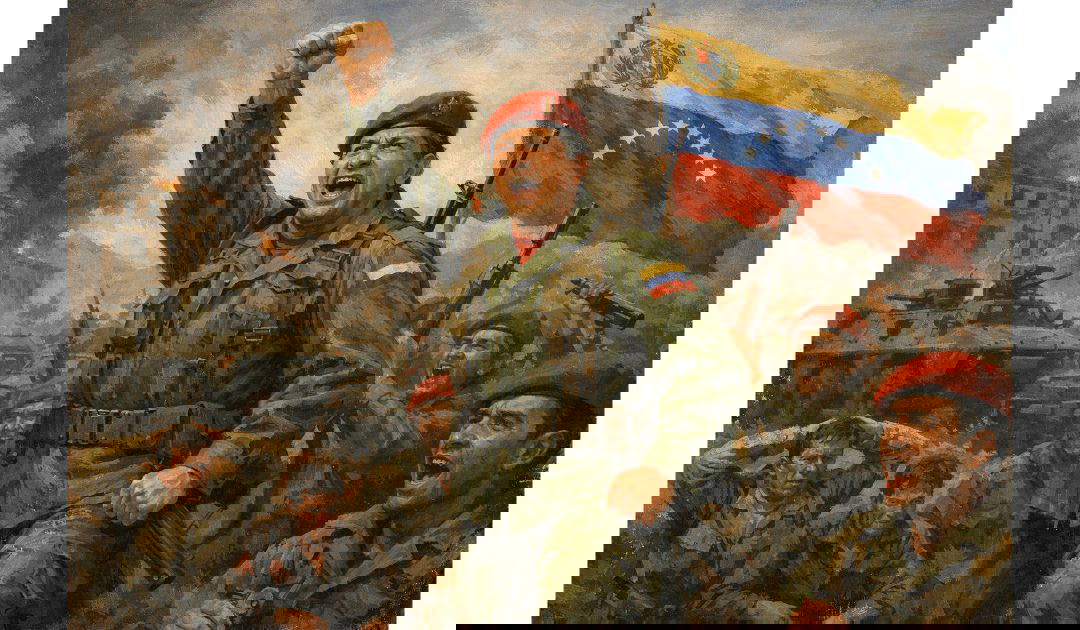
Well Venezuela has been in the news recently, and on the 4th of February, 1992, Hugo Chávez led a coup against Venezuelan President, Carlos Andrés Pérez. Claire and I have visited several South American countries including Chile (en-route to Antarctica), Peru, Bolivia, Paraguay, Argentina, and Brazil. We enjoyed all of them, although Argentina still seem to think the Falklands are theirs. I’d like to visit Mexico, and possibly Colombia, but Venezuela isn’t on my bucket list.
The land that would become Venezuela was long inhabited by diverse indigenous peoples, including Arawak and Carib groups, who lived across coastal plains, river valleys and the Andes with rich cultures and complex social structures. Archaeological evidence suggests these groups engaged in agriculture, hunting, fishing and trade long before European contact.
In 1498, during his third voyage to the Americas, Christopher Columbus arrived on the Venezuelan coast. Spanish explorers named the region Venezuela, meaning “Little Venice,” after seeing indigenous houses built on stilts over water. Permanent Spanish settlements began in the early 16th century, with Cumaná founded in 1523. The colonial period was marked by exploitation of native peoples, extraction of wealth (including pearls), and expansion of Spanish authority.
Venezuela became one of the first Spanish American territories to take steps toward self-rule with the Revolution of the 19th of April, 1810, which formed the Supreme Junta of Caracas. This act ignited the Venezuelan War of Independence against Spanish rule. Venezuela declared independence on the 5th of July, 1811, athough the fight continued against royalist forces.
Simón Bolívar emerged as a central figure in the liberation of South America. After years of struggle, Venezuelan and patriot forces secured decisive victories, including at Carabobo in 1821, effectively ending Spanish power in the region. Venezuela joined the Republic of Gran Colombia, founded in 1819 with Caracas and Bogotá as major centers, but regional tensions soon fractured the union. By 1830, Venezuela became a fully independent republic.
Post-independence Venezuela was marked by political turbulence as regional strongmen — caudillos — vied for control. Leaders such as José Antonio Páez and Antonio Guzmán Blanco dominated politics through the 19th century, instituting reforms at times but often ruling through force and patronage. A major internal conflict, the Federal War (1858–1863), reshaped regional governance but left deep scars.
A transformative moment came with the rise of Cipriano Castro and later Juan Vicente Gómez in the early 20th century. Gómez’s nearly three-decade rule (1908–1935) brought political repression but also attracted foreign investment into newly discovered petroleum reserves. By the 1920s, Venezuela had become one of the world’s top oil exporters — a shift that would profoundly shape its economy.
Gómez’s death led to a gradual opening of political space. After World War II, a brief period of democratic reform occurred, including fair elections and the rise of civilian parties like Democratic Action (Acción Democrática). A military coup in 1948, however, interrupted this, and only in 1958 did another coup end military rule and usher in a democratic era.
From the late 1950s through the 1980s, Venezuela was often more stable and democratic than many of its Latin American neighbours. Oil wealth funded infrastructure, education and industrialization, and Venezuela played a major role in OPEC. But the dependence on oil also made the nation vulnerable to price fluctuations.
Economic challenges in the 1980s and 1990s, including stagnation and rising inequality, eroded public trust in traditional parties. In 1989, riots known as the Caracazo erupted over austerity measures. Military unrest followed, including two coup attempts in 1992 led by young officers including Hugo Chávez. Though initially unsuccessful, these actions propelled Chávez into the national spotlight.
Chávez won the 1998 presidential election campaigning on anti-corruption, social justice, and a promise to overhaul Venezuela’s political system. Once in power, he pushed a new Bolivarian Constitution in 1999, expanded social programs, and nationalized key industries — especially oil. Chávez’s tenure reshaped Venezuelan politics under what became known as the Bolivarian Revolution, marked by populist governance but also increasing centralization of power.
After Chávez’s death in 2013, Nicolás Maduro succeeded him. Declining oil prices, mismanagement, and sanctions deepened an economic crisis. Shortages of food and medicine, hyperinflation, and mass migration followed. Political polarization heightened with contested elections, protests, and competing claims to legitimacy both domestically and internationally.
By 2025, Maduro’s government claimed sweeping electoral victories amid boycotts and contested legitimacy by opposition groups. The economic collapse continued with Venezuela’s vast oil infrastructure decaying even as it holds some of the world’s largest proven oil reserves.
Enter, stage right, Donald Trump. In January 2026, a U.S. military operation captured Nicolás Maduro, citing narcotics and terrorism charges, and an interim administration under Delcy Rodríguez was installed with foreign backing. This move triggered international debate about sovereignty, legitimacy, and control over Venezuela’s oil resources, which remain central to global geopolitical interests.
Venezuela’s history is a tapestry of indigenous cultures, colonial conquest, fierce battles for independence, oil-fueled modernization, democratic experiments and deep political and economic crises. Its strategic resources and turbulent governance continue to shape its role on the world stage — reflecting both the potential and challenges of this nation at the northern tip of South America.