
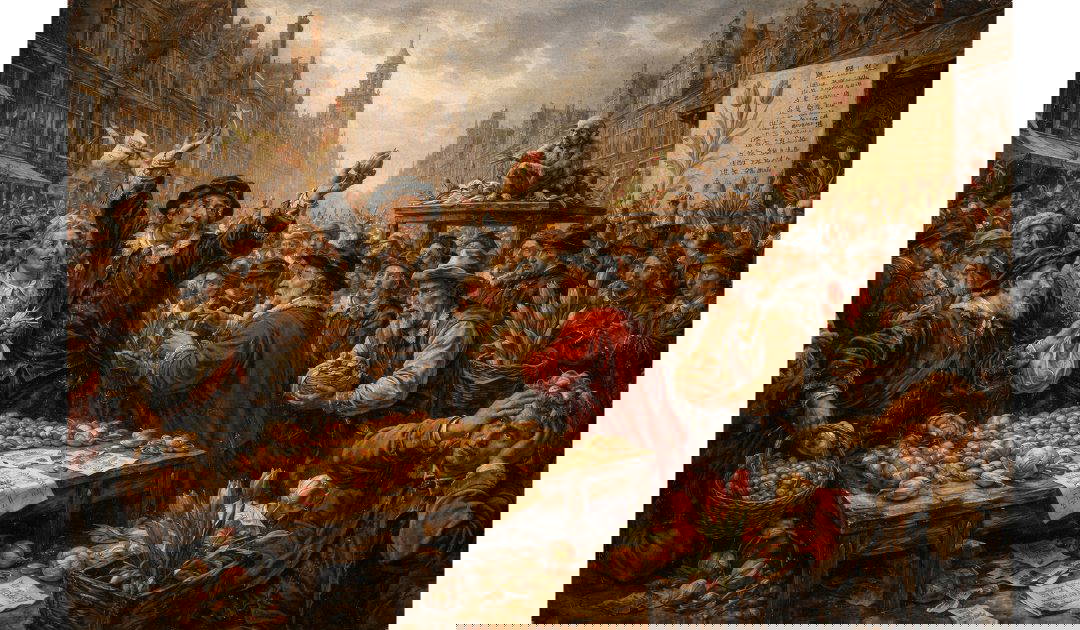
On the 3rd of February, 1637, Tulip Mania collapsed in the Dutch Republic. I have recently been asked for investment advice by a friend who had invested heavily in various crackpot investment schemes, followed by rental properties which didn’t work for him. He is now invested in an S&P500 tracker fund, but is worried about the AI “bubble”. I suggested a FTSE100 tracker, but he shuns European stocks. Personally I think AI may collapse, but that it will get up again. It does have utility, whereas tulips were simply decorative.
Tulip mania was a speculative frenzy that swept through the Dutch Republic in the 1630s and has since become one of the most famous examples of an economic bubble. Though often exaggerated in popular retellings, it remains a revealing episode in the history of capitalism, illustrating how social prestige, novelty, and speculation can combine to drive prices far beyond intrinsic value.
Tulips were not native to the Netherlands. They originated in Central Asia and reached Western Europe in the sixteenth century, likely via the Ottoman Empire. By the late 1500s, tulips had become fashionable curiosities among European elites, prized for their vivid colours and elegant form. In the Dutch Republic—a prosperous, urbanised, and commercially sophisticated society—tulips found especially fertile ground. Wealthy merchants and regents cultivated gardens as symbols of refinement, and rare flowers became status objects comparable to fine art.
What made tulips particularly desirable were “broken” varieties, whose petals displayed dramatic streaks and flames of contrasting colour. These patterns were later discovered to be caused by a virus, but at the time they were seen as natural marvels. Because such tulips were difficult to propagate and unpredictable, rarity drove their value higher. Named varieties such as Semper Augustus or Viceroy became famous, and ownership conferred social distinction.
By the early 1630s, the tulip trade had expanded beyond botanists and aristocrats into wider mercantile circles. What began as a trade in physical bulbs increasingly became speculative. Tulip bulbs are planted in autumn and lifted in summer, meaning they could only be physically exchanged during certain months. To overcome this, traders developed contracts to buy and sell bulbs at a future date. These agreements, often made in taverns, allowed participants to speculate on price movements without ever seeing the flower itself.
Prices began to rise rapidly, especially in 1636 and early 1637. Bulbs were exchanged multiple times before they were ever planted, with each buyer hoping to sell on at a profit. Stories circulated—some contemporary, others later embellished—of single bulbs selling for sums equivalent to a skilled craftsman’s annual income, or even the price of a fine house on an Amsterdam canal. While such extremes were rare, there is no doubt that prices for certain varieties reached extraordinary levels.
The social character of tulip mania is important. It did not involve the entire Dutch population, nor did it ruin the national economy. Participants were largely merchants, artisans, and investors who already had some disposable wealth. Nonetheless, the atmosphere became feverish. Pamphlets, satirical prints, and moralising sermons of the period reflect both fascination and unease, portraying tulip traders as gamblers driven by greed and folly.
The collapse came swiftly. In February 1637, at a routine bulb auction in Haarlem, buyers failed to appear or refused to meet the high asking prices. Confidence evaporated almost overnight. As prices stalled, then fell, many traders discovered that the contracts they held were unenforceable or worthless. Since most deals had been made informally, often on credit, the losses were more psychological and reputational than legally binding.
In the aftermath, the Dutch authorities attempted to stabilise the situation. Proposals were made to allow contracts to be cancelled for a small fee, effectively transforming them into options rather than binding purchases. While there was confusion and dispute, there was no widespread financial collapse. The Dutch economy, diversified and resilient, continued to prosper in trade, shipping, and finance.
Tulip mania acquired its legendary status largely through later accounts, particularly Charles Mackay’s nineteenth-century book Extraordinary Popular Delusions and the Madness of Crowds. Mackay presented the episode as a cautionary tale of collective insanity, often exaggerating its scale and social impact. Modern historians have offered a more nuanced view, emphasising that the mania was limited in scope and that its economic damage was relatively modest.
Nevertheless, tulip mania endures as a powerful symbol. It highlights how markets can detach prices from underlying value when novelty, scarcity, and social imitation take hold. It also demonstrates that speculative bubbles are not a modern invention tied solely to stock markets or complex financial instruments; they can arise wherever human psychology intersects with trade.
In essence, tulip mania was less about flowers than about belief—belief that prices would continue to rise because others were willing to pay more. When that belief collapsed, so too did the market. For this reason, the tulip craze of the 1630s remains a compelling early chapter in the long history of financial speculation.