
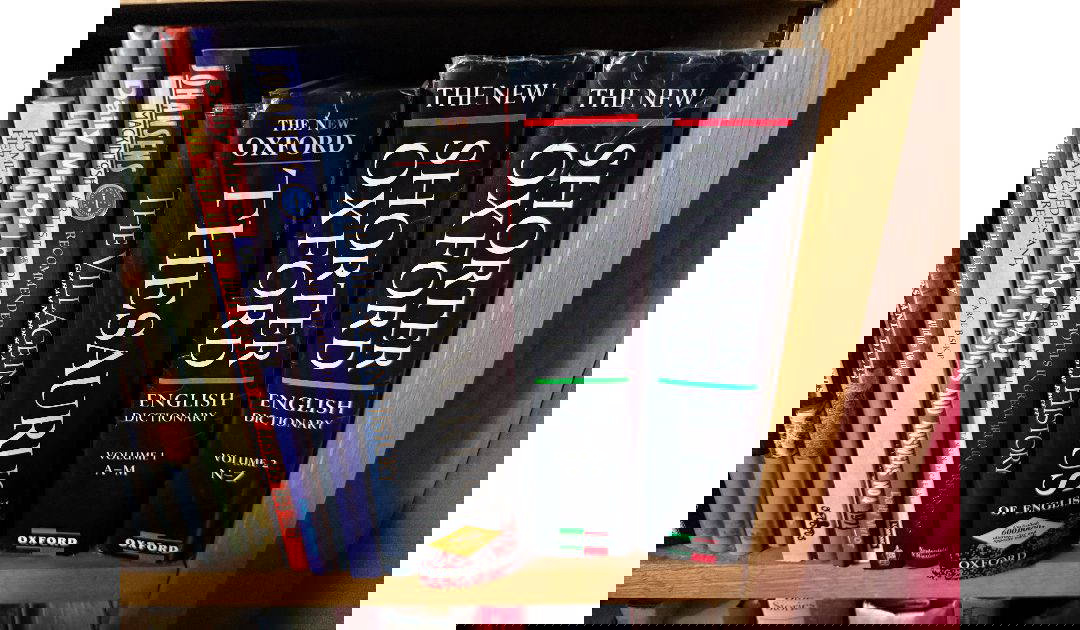
History need not be defined by battles, leaders, exploration, or adventure. I choose as my topic today, the Oxford English Dictionary, of which the first volume (A – Ant) was first published on the 1st of February, 1884. Claire gave me the two volume Shorter Oxford Dictionary some years ago. I think you can see from the dust cover that it has been pulled from the shelf on a regular basis.
The Oxford English Dictionary (OED) is widely regarded as the most authoritative and comprehensive record of the English language ever produced. More than a dictionary of meanings, it is a historical chronicle that traces the life of words across centuries, showing how English has evolved through literature, science, politics, and everyday speech. Its scope, methodology, and scholarly ambition make it a unique cultural achievement.
The origins of the OED lie in the mid-nineteenth century, a period when English was expanding rapidly due to industrialisation, empire, and advances in science. Existing dictionaries were considered inadequate, often selective and impressionistic rather than systematic. In 1857, the Philological Society of London proposed the creation of a new dictionary that would document every word in the English language, from its earliest appearance to its most recent usage. This ambitious project was initially known as “A New English Dictionary on Historical Principles”.
The dictionary’s defining innovation was its historical approach. Instead of merely listing meanings, the editors sought to show how words developed over time. Each sense of a word would be illustrated with dated quotations drawn from real texts, demonstrating shifts in spelling, meaning, and usage. This method required an unprecedented collection of evidence. Thousands of volunteers—schoolteachers, clergy, academics, and ordinary readers—were recruited to read widely and submit quotation slips. By the end, millions of these slips had been amassed.
One of the most remarkable figures associated with the OED is James Murray, appointed editor in 1879. Working from a corrugated iron shed in his Oxford garden—famously known as the “Scriptorium”—Murray coordinated a global network of contributors. His dedication was extraordinary: he learned dozens of languages to handle etymologies properly and oversaw a project that would far outlive him. Among the dictionary’s contributors was the American surgeon William Chester Minor, who, despite being confined to Broadmoor, an asylum, supplied thousands of meticulously chosen quotations—an episode that has since become legendary.
The first fascicle of the dictionary appeared in 1884, but progress was slow. The scale of the task had been vastly underestimated. The first complete edition, consisting of twelve volumes, was finally published in 1928, more than seventy years after the project had begun. Even then, the work was not finished. A supplementary volume followed in 1933, and later supplements were issued throughout the twentieth century to account for new words and meanings.
In 1989, the OED entered a new phase with the publication of the Second Edition, which merged the original text and supplements into a single, expanded work of twenty volumes. This edition contained over half a million words and senses, supported by around 2.5 million quotations. Soon after, digitisation transformed the dictionary again. The online OED, launched in 2000, allows for continuous updating rather than periodic revisions, reflecting the living nature of the language.
Today, the OED documents not only traditional literary English but also regional dialects, technical vocabulary, slang, and words borrowed from other languages. It records the influence of global Englishes, from India and the Caribbean to Africa and Australasia, acknowledging that English is no longer owned by any single nation. Modern entries may cite sources ranging from medieval manuscripts to social media and contemporary journalism.
Beyond its practical use, the Oxford English Dictionary holds deep cultural significance. It reveals how social change shapes language: how new technologies generate new words, how political upheavals alter meanings, and how attitudes toward gender, race, and identity are reflected in vocabulary. To read the OED is to read a history of thought as much as a guide to words.