
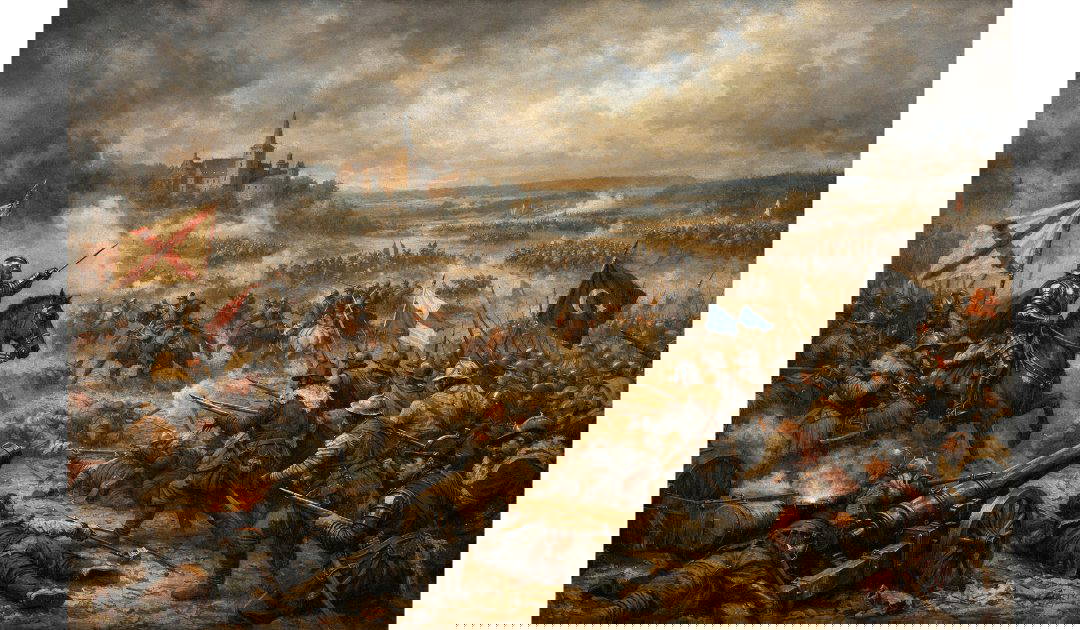
The Battle of Gembloux was fought on the 31st of January, 1578, during the Eighty Years’ War. The Spanish forces were commanded by Don Juan, Duke of Austria. Regular readers will know that the Eighty Years’ War was the conflict in which my ancestor, Sir Anthony Standen, was spying for Francis Walsingham. They may also know that Anthony had to flee the Netherlands when Don Juan caught him in an inappropriate relationship with Barbara Blomberg, who was Don Juan’s mother. But let us get back to the battle.
By the late 1570s, the Netherlands were deeply divided by a combination of political, religious, and economic tensions. Many provinces had risen against Spanish rule, protesting heavy taxation, the presence of foreign troops, and the enforcement of Catholic orthodoxy in regions where Protestantism—especially Calvinism—had taken hold. The Pacification of Ghent in 1576 had briefly united Catholic and Protestant provinces in opposition to Spanish military occupation, but this fragile unity soon began to fracture.
Spain responded by appointing Don Juan of Austria, the illegitimate half-brother of Philip II and hero of the naval victory at Lepanto, as governor-general of the Netherlands. Although initially conciliatory, Don Juan soon returned to military solutions when negotiations collapsed. By early 1578, a rebel army—largely composed of troops from the States General, German mercenaries, and Walloon forces—was advancing into central Brabant, threatening Spanish positions.
The Spanish army was commanded by Don Juan of Austria, with his most capable lieutenant, Alexander Farnese, Prince of Parma, playing a crucial tactical role. Spanish forces numbered roughly 20,000 men, including veteran tercios—units famed for their discipline, pike-and-shot formations, and battlefield cohesion.
Opposing them was a larger but less cohesive rebel army of approximately 25,000–30,000 troops, led nominally by Antoine de Goignies and Philip of Lalaing, Count of Lalaing. While numerically superior, the rebel force suffered from divided command, uneven training, and questionable morale, especially among mercenary contingents whose loyalty often depended on regular pay.
The armies met near Gembloux, in present-day Belgium. The terrain consisted of rolling farmland crossed by narrow roads and small villages—hardly ideal for large-scale manoeuvres, but favourable to disciplined troops capable of rapid, coordinated action.
The battle unfolded quickly. As the rebel army attempted to withdraw toward Gembloux in marching columns, Spanish cavalry under Farnese launched a sudden and aggressive attack on the rebel rear guard. This strike caused confusion and panic, particularly among the German mercenaries, who broke formation. Seeing the enemy disordered, the Spanish infantry advanced relentlessly.
What followed was less a prolonged battle than a catastrophic collapse. Spanish troops exploited gaps in the rebel lines, turning retreat into rout. Units fled without orders; artillery was abandoned; entire formations disintegrated. The Spanish cavalry pursued the fleeing enemy mercilessly across the countryside, inflicting heavy casualties.
Within hours, the rebel army had ceased to exist as an effective fighting force. Estimates of rebel losses range from 5,000 to over 10,000 killed, with thousands more captured. Spanish casualties were remarkably light by comparison, reportedly only a few dozen killed.
The victory at Gembloux was a major triumph for Spain and a personal success for Don Juan of Austria, though he would die later that same year. More enduring was the rise of Alexander Farnese, whose leadership at Gembloux foreshadowed his later achievements as Spain’s greatest commander in the Netherlands.
Strategically, the battle shattered the military power of the States General at a crucial moment. It exposed the weaknesses of the rebel coalition: poor coordination, reliance on mercenaries, and internal political divisions. In the wake of Gembloux, several southern provinces—predominantly Catholic—began to reconsider their allegiance to the rebellion.
This shift culminated in the Union of Arras (1579), in which southern provinces reconciled with Spain, while the northern provinces responded by forming the Union of Utrecht, laying the foundation for the future Dutch Republic. In this sense, Gembloux helped accelerate the permanent division of the Low Countries into what would become Belgium and the Netherlands.
The Battle of Gembloux is a textbook example of how discipline, leadership, and battlefield cohesion can outweigh numerical superiority. It reaffirmed the fearsome reputation of the Spanish tercios and marked a turning point in the Eighty Years’ War. Though the conflict would continue for decades, Gembloux ensured that the revolt would no longer be a united national uprising, but a divided struggle whose outcome would reshape the political map of north-western Europe.