
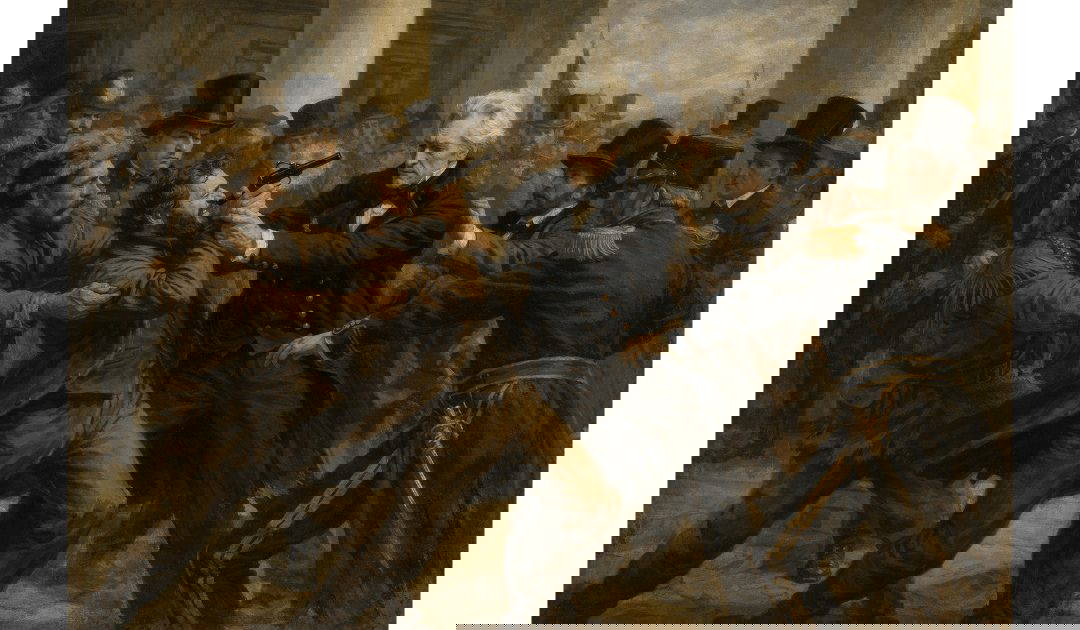
For the 30th of January I am drawn to two candidates for my post. They are Adolph Hitler, who took office as Chancellor of Germany on this day in 1933, and Richard Lawrence who in 1835 made the first assassination attempt against a President of the United States when he attempted to shoot Andrew Jackson. I haven’t really written much about Adolph Hitler except for a brief mention, I suppose I don’t want to, but perhaps I should. I remember Peter Sellers dressed as a German soldier on the Parkinson show complaining about Churchill and his “rotten paintings. Hitler, there was a painter, entire apartment, two coats, one afternoon.” Now I don’t think Hitler was a house painter, but Richard Lawrence was.
Richard Lawrence, the man who attempted to assassinate President Andrew Jackson in 1835, occupies a grim but revealing place in American history. His failed attack—remarkable both for its dramatic circumstances and its outcome—was the first known assassination attempt against a sitting president. Lawrence’s life and actions illuminate early nineteenth-century urban poverty, untreated mental illness, and the intense political symbolism attached to Andrew Jackson himself.
Richard Lawrence was born in England around 1800 and emigrated to the United States as a young man. He settled in Washington, D.C., where he worked intermittently as a house painter. By all accounts, Lawrence lived on the margins of society. He was poor, often unemployed, and increasingly isolated. Over time, acquaintances noticed disturbing changes in his behavior, including grandiose delusions and paranoia. These symptoms would later prove central to understanding his actions.
Lawrence developed a fixed belief that he was the rightful heir to the British throne. He claimed to be Richard III of England reborn or divinely appointed, asserting that enormous sums of money were owed to him by the British government. When he failed to obtain these imaginary funds, he became convinced that President Andrew Jackson was personally responsible for blocking his access to his “inheritance.” In Lawrence’s disordered thinking, killing Jackson would remove the obstacle standing between him and his rightful fortune.
Andrew Jackson, the seventh president of the United States, was a deeply polarizing figure. Revered by supporters as a champion of the common man and reviled by critics as an authoritarian demagogue, Jackson attracted intense personal loyalty and equally intense hatred. By 1835, he had survived fierce political battles over the national bank, states’ rights, and executive power. Lawrence’s obsession with Jackson, however, was not ideological in any coherent sense; it was the product of untreated psychosis rather than political radicalism.
The assassination attempt occurred on the 30th of January, 1835, as Jackson was leaving the Capitol after attending the funeral of Congressman Warren R. Davis. As the president stepped outside onto the East Portico, Lawrence approached him at close range and fired a pistol. The weapon misfired. Lawrence immediately drew a second pistol and fired again. Astonishingly, that gun also misfired. Later examination revealed that the pistols were functional; damp winter conditions may have affected the percussion caps.
Jackson, then sixty-seven years old and suffering from numerous chronic illnesses, reacted with characteristic ferocity. He lunged toward Lawrence, attempting to strike him with his cane. Members of Jackson’s entourage and bystanders, including Congressman Davy Crockett, rushed forward to restrain the would-be assassin. Lawrence was subdued, beaten, and taken into custody. Jackson reportedly had to be physically pulled away from the struggle.
Lawrence’s trial took place later in 1835 and quickly became a test case for the insanity defense in American law. His erratic behavior, delusional claims, and inability to understand the proceedings convinced many observers that he was profoundly mentally ill. A jury found him not guilty by reason of insanity, a verdict that sparked public debate. Some Americans were outraged that a man who had tried to kill the president would escape execution, while others saw the decision as a humane recognition of mental illness.
Rather than being released, Lawrence was committed to a government-run asylum, first at the Washington Asylum Hospital and later at St. Elizabeths Hospital, where he would spend the rest of his life. He remained delusional, continuing to assert his royal identity and refusing to acknowledge wrongdoing. Lawrence died in confinement in 1861, largely forgotten as the nation descended into civil war.
Richard Lawrence’s legacy lies not in political impact but in historical precedent. His failed attack led to increased awareness of presidential security, though formal protective services would not be established until decades later. More importantly, his case highlighted the realities of mental illness in an era when psychiatric care was rudimentary and social safety nets were minimal.
Lawrence was not a revolutionary, a partisan zealot, or a symbol of organized opposition. He was a deeply unwell man whose personal delusions collided with the immense symbolic power of the presidency. His story serves as a sobering reminder that history is sometimes shaped not only by ideology and ambition, but by human fragility and neglect.