
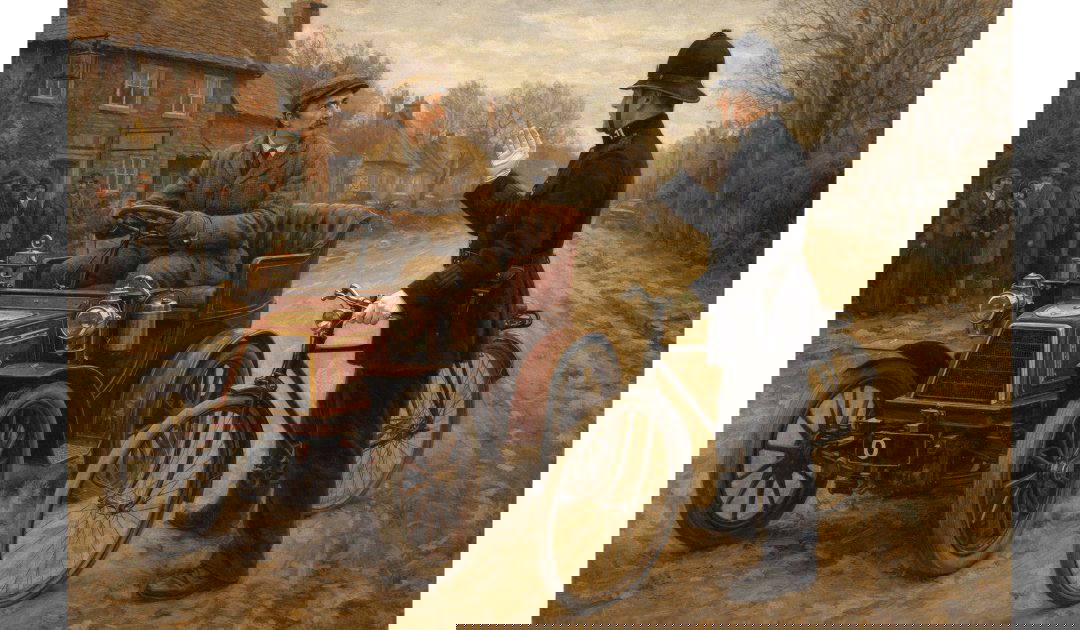
Looking for subjects to write about today, I can hardly believe that I am going to pass over the publication of Jane Austen’s Pride and Prejudice in favour of Walter Arnold of East Peckham. Don’t tell my wife, Claire, or I’ll be in trouble. I’ll make it up to Jane Austen, I promise.
Walter Arnold was the first person to be convicted of speeding. He was driving at 8 mph whilst the speed limit was 2mph. This was on the 28th of January 1896. I mean, really, my comfortable walking pace is just over 4 mph.
The history of speed limits for motor vehicles is closely tied to the emergence of the automobile itself and to society’s attempts to balance innovation, safety, and public order. From the earliest days of mechanised transport, speed has been both a symbol of progress and a source of anxiety, prompting governments to regulate how fast vehicles could travel long before cars became common.
The first speed limits predate the motor car. In the early nineteenth century, steam-powered road vehicles appeared in Britain, provoking concern among pedestrians, horse-drawn traffic, and road authorities. The Locomotive Acts of 1861 and 1865 imposed stringent restrictions on these early machines. The most famous of these, the 1865 “Red Flag Act,” limited speeds to 2 miles per hour in towns and 4 miles per hour in the countryside and required a person to walk ahead of the vehicle carrying a red flag to warn others. These measures were less about precise safety science than about protecting existing road users and industries, particularly horse transport. In practice, they effectively stifled the development of motor vehicles in Britain for decades.
As petrol-driven cars emerged in the late nineteenth century, speed limits were gradually relaxed. In Britain, the 1896 Locomotives on Highways Act raised the speed limit to 14 miles per hour and abolished the red flag requirement. This change was celebrated by motorists in the famous “Emancipation Run” from London to Brighton. Even so, enforcement could be strict, as demonstrated by the case of Walter Arnold, fined in 1896 (often reported as 1898) for driving at 8 miles per hour in a 2-mile-per-hour zone—one of the earliest recorded speeding convictions.
Elsewhere, speed regulation developed unevenly. In France and Germany, where automobile development was more warmly embraced, early speed limits were often higher or left to local authorities. In the United States, early motor laws were set at the state or municipal level. By the 1900s, many American cities imposed limits of around 10 to 15 miles per hour, reflecting fears about pedestrian safety in increasingly crowded urban streets. Rural areas, by contrast, often had few or no limits, allowing drivers to travel as fast as conditions permitted.
The early twentieth century saw rapid increases in vehicle speed and traffic density, leading to growing public concern about accidents. Speed limits became a central tool for managing this risk. By the 1920s and 1930s, many countries had adopted differentiated limits based on location: lower speeds in towns and higher ones on open roads. In Britain, the Road Traffic Act of 1930 controversially abolished speed limits for cars altogether, on the assumption that competent drivers would regulate themselves. The result was a sharp rise in fatalities, particularly among pedestrians.
This experiment proved short-lived. In 1934, Britain reintroduced a 30 miles per hour limit in built-up areas, a figure chosen as a compromise between mobility and safety. This limit, remarkably, remains in force today. Other countries followed similar paths, recognising that unregulated speed posed unacceptable risks as vehicle numbers soared.
After the Second World War, advances in road engineering and car design led to higher speeds, especially on new motorways. Germany’s Autobahn network famously adopted advisory speed limits rather than mandatory ones on many sections, reflecting confidence in road quality and driving standards, though urban and hazardous stretches remained regulated. Elsewhere in Europe, motorway limits typically settled between 70 and 80 miles per hour (or their metric equivalents).
In the United States, speed limits became entangled with broader political and economic issues. During the 1973 oil crisis, the federal government imposed a nationwide maximum speed limit of 55 miles per hour to conserve fuel. Although this measure reportedly reduced fatalities and fuel consumption, it was unpopular with many drivers and unevenly enforced. By the late 1980s and 1990s, states were again permitted to raise limits, and today American speed limits vary widely depending on state and road type.
In recent decades, speed limits have increasingly been informed by scientific research into road safety. Studies linking speed to injury severity and reaction time have reinforced the case for lower limits in urban areas. Many cities have adopted 20 miles per hour (or 30 km/h) zones in residential neighbourhoods, prioritising pedestrian and cyclist safety. At the same time, intelligent transport systems, speed cameras, and average-speed monitoring have transformed enforcement, making speed limits more than symbolic rules.
The history of speed limits thus reflects changing attitudes toward technology, risk, and responsibility. From walking-pace restrictions enforced by red flags to modern debates about smart speed limiters and autonomous vehicles, speed regulation has evolved alongside society itself. It remains a dynamic compromise between the desire to move faster and the enduring need to protect life on the road.