
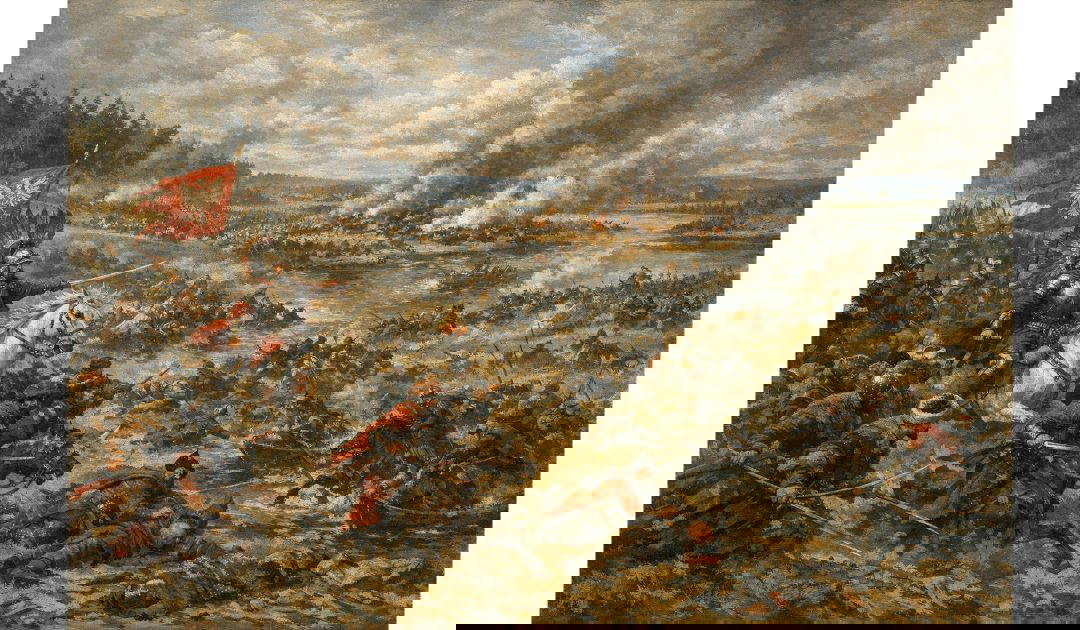
The Battle of Ula was fought on the 26th of January, 1564, between the Grand Duchy of Lithuania, and (guess who) Russia. Guess who won, (spoiler alert) Lithuania. It was one of the most important Lithuanian victories over Tsardom of Muscovy in the sixteenth century. Though relatively small in scale by later standards, the battle had major strategic and psychological consequences, halting Russian momentum in the region and demonstrating that Ivan IV’s armies were not invincible.
Historical Context
The battle must be understood within the broader framework of the Livonian War, a protracted struggle for control of the eastern Baltic region. Tsar Ivan IV (“the Terrible”) sought access to the Baltic Sea in order to strengthen Muscovy’s trade links with Western Europe and elevate his state to great-power status. Beginning in 1558, Muscovite forces overran much of Livonia, exploiting the weakness of the Livonian Confederation. This rapid expansion alarmed neighbouring powers, especially the Grand Duchy of Lithuania, which shared long and vulnerable borders with Muscovy.
By the early 1560s, Muscovy had pushed well beyond Livonia into Lithuanian territory. The situation became critical in 1563 when Ivan IV captured the major fortress of Polotsk, a devastating blow to Lithuanian defences and prestige. With Muscovite armies advancing and Vilnius potentially threatened, Lithuania faced one of the gravest crises in its history.
Commanders and Armies
The Lithuanian forces were commanded by Mikołaj “the Red” Radziwiłł, Grand Hetman of Lithuania and one of the most powerful magnates of the realm. Radziwiłł was an experienced commander who understood both Muscovite tactics and the strengths of Lithuanian cavalry warfare. His army was relatively small, estimated at around 4,000–6,000 men, composed largely of cavalry, including light cavalry well suited to rapid manoeuvre, supported by smaller numbers of infantry and artillery.
The Muscovite army was led by Prince Pyotr Shuisky and was significantly larger, with estimates ranging from 15,000 to over 20,000 troops. It included heavy cavalry (boyar cavalry), infantry, and artillery, and was part of a larger campaign intended to exploit the capture of Polotsk and push deeper into Lithuanian lands.
The Battle Itself
The engagement took place near the Ula River, a tributary of the Daugava (Western Dvina), in what is now Belarus. Radziwiłł avoided a direct, frontal engagement, which would have favoured the numerically superior Muscovite army. Instead, he carefully selected terrain and relied on surprise and speed.
Lithuanian forces launched a sudden and well-coordinated attack on the Muscovite column, which was stretched out and insufficiently prepared for battle. The Lithuanian cavalry struck decisively, disrupting Muscovite formations before they could properly deploy. Panic spread rapidly among Shuisky’s troops, exacerbated by poor coordination and command failures. The Muscovite army collapsed into disorder, with many soldiers fleeing or being cut down during the rout.
Prince Shuisky was killed during the fighting, a blow that further demoralised Muscovite forces. Lithuanian troops captured artillery, banners, and supplies, while inflicting heavy casualties on the enemy. Although exact losses are uncertain, Muscovite casualties were substantial, while Lithuanian losses were comparatively light.
Aftermath and Significance
The victory at Ula had consequences far beyond the battlefield. Militarily, it halted Muscovy’s advance into Lithuanian territory and forced Ivan IV to reconsider the vulnerability of his western campaigns. While the war itself continued for many years, the battle demonstrated that Muscovite armies could be defeated through superior leadership and tactics rather than sheer numbers.
Politically, the victory restored confidence within the Grand Duchy of Lithuania after the devastating loss of Polotsk. It strengthened Radziwiłł’s position and enhanced his reputation as one of the most capable commanders of his generation. The battle also helped stabilise Lithuania at a moment when internal strain and external pressure threatened its survival as an independent power.
Strategically, Ula influenced the evolving relationship between Lithuania and Poland. Continued Muscovite pressure would eventually contribute to the Union of Lublin in 1569, creating the Polish–Lithuanian Commonwealth. Victories such as Ula delayed Muscovite dominance long enough for this political transformation to occur.
Historical Importance
Although overshadowed by larger battles of later centuries, the Battle of Ula remains a classic example of how intelligence, leadership, and tactical surprise can overcome numerical inferiority. It stands as one of the most notable Lithuanian military successes of the sixteenth century and a rare moment when Muscovy’s westward expansion was decisively checked. In the broader narrative of Eastern European history, Ula marks a turning point where balance, rather than conquest, briefly returned to the region.