
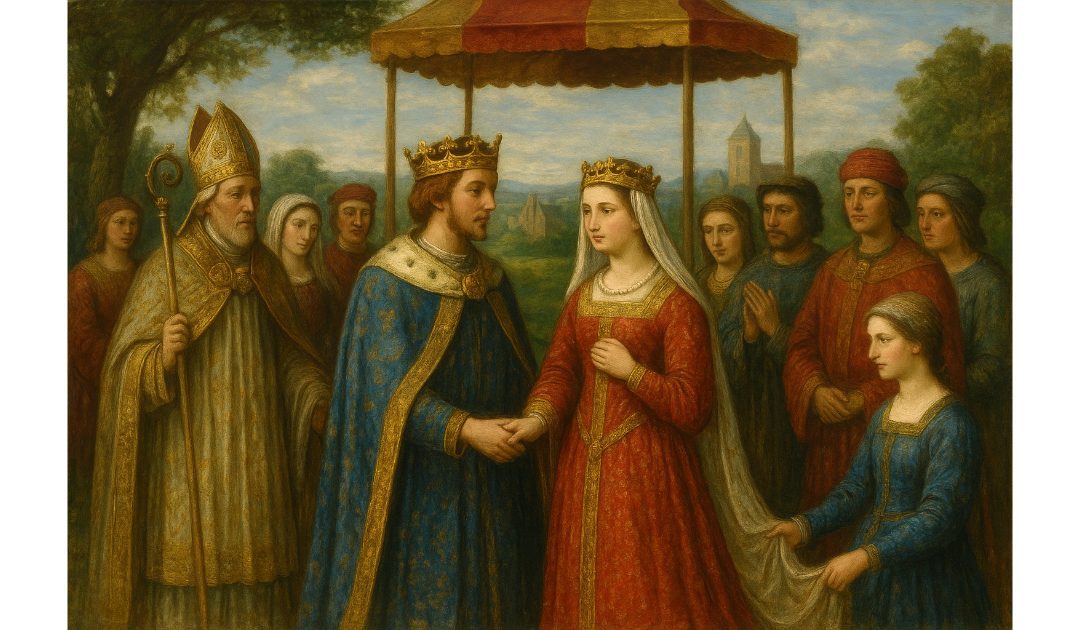
On the 14th of January, 1296, King Henry III of England married Eleanor of Provence. King Henry III of England, who reigned from 1216 to 1272, is one of the longest-serving monarchs in English history and a figure whose rule bridged the turbulent aftermath of the Norman era and the emerging structures of later medieval governance. His 56-year reign was marked by immense cultural flourishing, intense political struggle, and a constant tug-of-war between royal authority and baronial power. Though not a warrior king like his father, King John, or his son, Edward I, Henry III left a distinct legacy shaped by piety, architectural patronage, and earnest—if often misguided—attempts to govern a realm still recovering from civil strife.
Henry became king at just nine years old, at a moment of national crisis. His father, King John, had died while England was in the midst of the First Barons’ War, and large parts of the kingdom were held by rebel nobles supporting Prince Louis of France. The boy king was crowned quickly at Gloucester, without the usual ceremony or regalia, and power fell into the hands of his early ministers, particularly the capable William Marshal, Earl of Pembroke. Under Marshal’s leadership, the royalists defeated the rebels and expelled the French, allowing Henry’s minority government to restore a degree of stability.
During Henry’s early reign, counsellors such as Marshal and Hubert de Burgh re-established royal authority and re-issued Magna Carta, thus recognising the political realities born out of John’s misrule. These early decades set expectations that the king was bound by law and custom, a principle Henry accepted in word but struggled with in practice once he reached adulthood.
Henry assumed personal control of government in the 1230s and soon displayed the characteristics that would define his long reign. Deeply pious, he fostered religious orders, endowed monasteries, and cultivated the cult of the saint-king Edward the Confessor—whom he admired so intensely that he later rebuilt Westminster Abbey in Edward’s honour. Henry’s interest in art, architecture, and ceremony brought a refined cultural atmosphere to the court. The Gothic splendour of the new Westminster Abbey, initiated in 1245, remains one of the clearest representations of Henry’s aesthetic vision and one of the greatest architectural achievements of medieval Europe.
Yet his personal qualities were a mixed blessing. Henry was devout, courteous, and generous, but he was also indecisive, easily influenced by favourites, and prone to financial mismanagement. His expensive building projects, large royal household, and ambitious attempts to secure foreign territories—most notably his disastrous involvement in Sicily on behalf of the papacy—placed enormous strain on the royal treasury. This in turn pushed him to seek new taxes, provoking resentment among the nobility.
A major source of tension was Henry’s preference for foreign advisers and relatives, including his Lusignan half-brothers and his wife’s Savoyard kin. Many English barons viewed these men as greedy interlopers who enjoyed undue influence over the king. Discontent grew through the 1240s and 1250s, eventually coalescing around the figure of Simon de Montfort, Earl of Leicester. De Montfort, once the king’s close ally, became a champion of reform when Henry’s financial recklessness and perceived favouritism became intolerable to the political community.
In 1258, the crisis exploded. A group of leading nobles confronted Henry at Westminster and compelled him to accept the Provisions of Oxford, a radical set of reforms establishing a baronial council to oversee the government. For the first time, the nobility sought to enforce systematic controls on royal authority rather than relying on ad-hoc concessions. Though Henry initially agreed to these reforms, he later repudiated them with papal support, plunging England into the Second Barons’ War.
The conflict reached its apex in 1264–65. Simon de Montfort defeated the royal forces at the Battle of Lewes in 1264, captured Henry and his son Prince Edward, and effectively ruled the kingdom. De Montfort summoned a groundbreaking parliament in early 1265, inviting not only nobles and bishops but also representatives of towns—an important milestone in the development of the English parliamentary tradition. However, his regime was short-lived. Prince Edward escaped captivity, rallied royalist forces, and crushed de Montfort at the Battle of Evesham in August 1265. De Montfort was killed, and Henry regained control, though the settlement of the realm fell largely to Edward, whose military vigour and political decisiveness contrasted sharply with his father’s softer nature.
The later years of Henry’s reign were more peaceful, as the king adopted a conciliatory tone and allowed Edward increasing influence. By the time of Henry’s death in 1272, the kingdom had broadly stabilised, and the structures of governance—especially parliament’s growing role—were stronger than they had been at the start of his rule.
Henry III’s reign, though lacking great conquests or dramatic victories, was one of immense transformation. His failures in finance and statesmanship helped provoke political reforms that would shape the English constitution for centuries. At the same time, his cultural patronage left a physical legacy unmatched by most medieval kings. In the balance of history, Henry III stands not as a mighty ruler, but as a monarch whose turbulent yet culturally rich reign laid groundwork for the England his formidable son would inherit.