
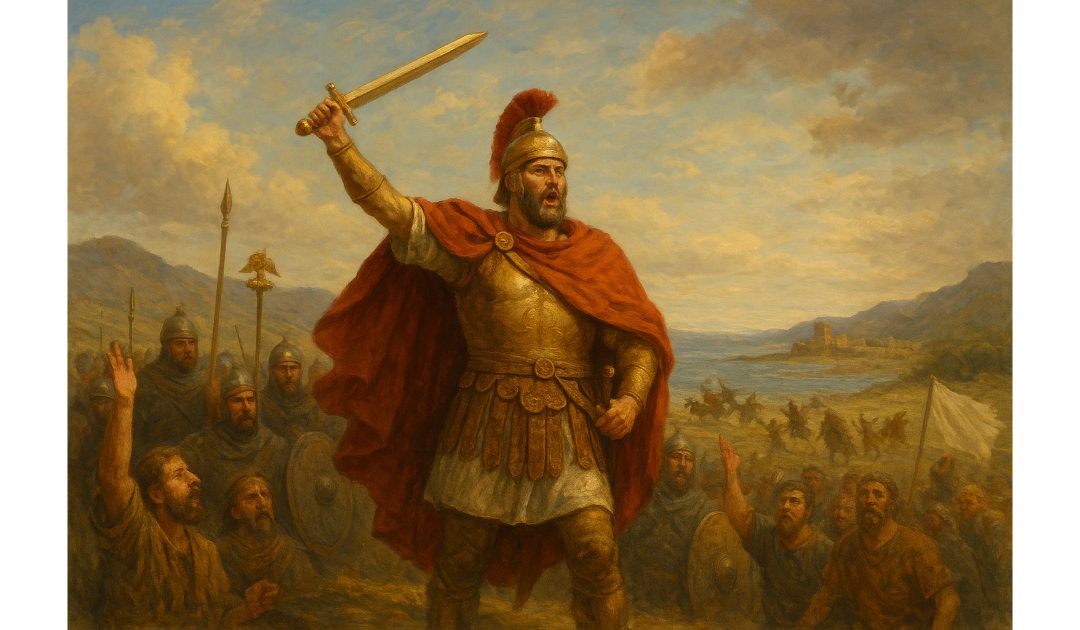
I recently posted about Vandals and their defeat by General Belisarius in 533CE. Oddly the first two events that I find for the 31st of December concern the Vandals and General Belisarius again. On this day in 406CE the Vandals, Alans and Suebians crossed the Rhine and began an invaluable of Gaul. Also on this day in 535CE General Belisarius completed his conquest of Sicily. The next foreign holiday that Claire and I have planned is a trip to Sicily, probably in the autumn next year. So perhaps it’s a good time to start researching the history of Sicily.
The earliest known inhabitants of Sicily were a mix of indigenous peoples such as the Sicani, thought to be the island’s first settlers; the Elymians, possibly of Anatolian origin; and the Sicels, who migrated from the Italian peninsula. Their societies were largely tribal, with settlements dispersed across the island’s hills and fertile plains. By the second millennium BCE, these groups engaged in trade with Mycenaean Greeks and Phoenicians, laying the foundations of Sicily’s role as a hub of Mediterranean exchange.
From the 8th century BCE, Greek colonisation began to transform the island. Pioneering settlers from Corinth and other city-states established prosperous colonies such as Syracuse, Agrigentum (modern Agrigento), and Selinus (Selinunte). These poleis thrived thanks to fertile land and maritime trade, and they became centres of Hellenic culture, art, and philosophy. Temples, theatres, and the remains of city walls still testify to their grandeur. Syracuse, in particular, rose to prominence under leaders like Dionysius I, rivaling Athens as a seat of learning and power.
Simultaneously, the Phoenicians, and later the Carthaginians, established settlements on the western side of the island, notably at Motya, Panormus (Palermo), and Soluntum. The coexistence of Greek and Carthaginian spheres led to centuries of conflict, with Sicily often serving as the battleground for their competing ambitions. This tension reached its peak during the Sicilian Wars, a series of struggles over control of the island in the 5th and 4th centuries BCE.
In the 3rd century BCE, Sicily became the focal point of Rome’s expansion during the Punic Wars. The First Punic War (264–241 BCE) saw the Romans seize control of the island from Carthage, marking Sicily as the first Roman province. The island’s rich grain fields became essential to Rome’s food supply, earning it the title of the Republic’s granary. Under Roman rule, Sicily prospered economically, with cities like Syracuse maintaining cultural importance while Roman villas and agricultural estates spread across the landscape.
With the fall of the Western Roman Empire in the 5th century CE, Sicily endured a period of upheaval. It was first invaded by the Vandals and then reclaimed by the Eastern Roman (Byzantine) Empire under Justinian I (he commissioned the Hagia Sophia) in the 6th century. Belisarius was Justinian’s general. Byzantine control introduced Orthodox Christianity and fortified urban centres but was challenged by the rise of Islamic powers. In the 9th century, Arab forces from North Africa conquered the island, establishing the Emirate of Sicily.
The Arab period (827–1091) was a golden era for agriculture, trade, and learning. The introduction of new irrigation techniques and crops such as citrus, cotton, and sugarcane transformed the landscape. Palermo became a major Mediterranean metropolis, known for its bustling markets, mosques, and palaces. The cultural fusion of Arab, Greek, and Latin traditions shaped the island’s evolving identity.
By the late 11th century, Norman warriors from Normandy embarked on a campaign to seize Sicily. Under the leadership of Roger I, and later his son Roger II, the Normans created a kingdom that combined Latin, Greek, and Arab influences in a unique cosmopolitan society. Norman Sicily became famous for its splendid architecture, including the Palatine Chapel in Palermo, which blends Byzantine mosaics with Islamic-inspired ceilings.
In the centuries that followed, Sicily passed through the hands of several European powers. The Hohenstaufen dynasty, the Angevins, and the Aragonese all ruled the island, often using it as a strategic base in Mediterranean politics. The 1282 Sicilian Vespers, a bloody revolt against French rule, marked a turning point, bringing the island under Aragonese and later Spanish control.
Spanish rule, which lasted into the 18th century, saw Sicily integrated into a vast overseas empire, though it also faced economic stagnation and social tensions marked by feudal inequalities. In the 18th and 19th centuries, Bourbon domination gave way to revolutionary fervour, particularly during the movements for Italian unification. Giuseppe Garibaldi’s famous expedition in 1860 led to Sicily’s annexation into the Kingdom of Italy. I’m really looking forward to visiting Sicily now, and I’m working on learning some Italian.