
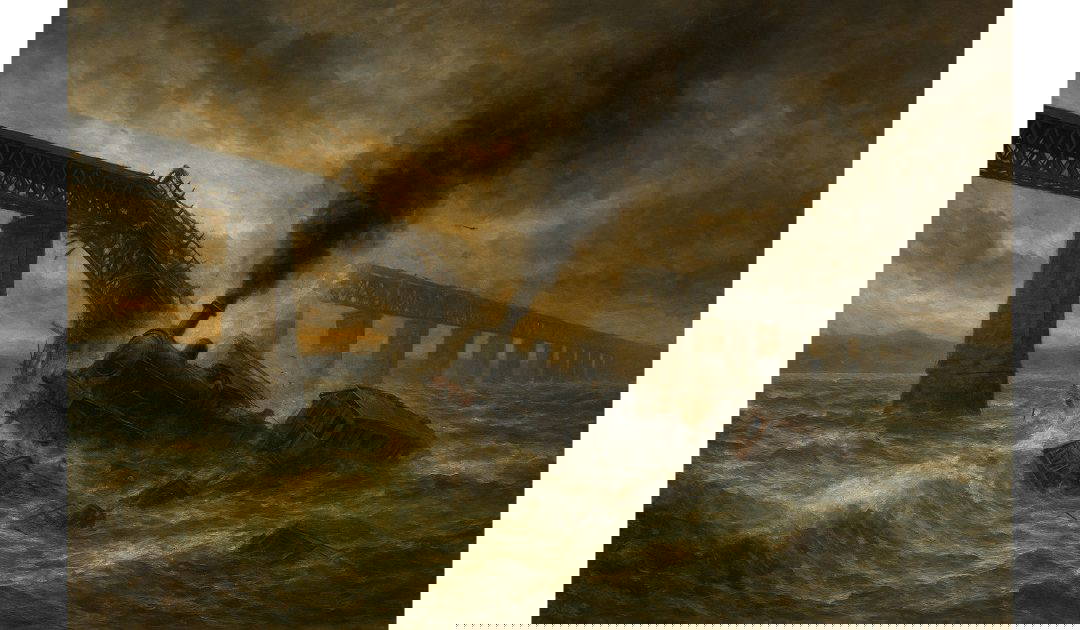
The Tay Bridge disaster, one of the most infamous engineering tragedies in British history, occurred on the evening of the 28th of December 1879. It involved the catastrophic collapse of a section of the original Tay Railway Bridge during a violent winter storm, sending a train and all its passengers into the freezing waters of the Firth of Tay near Dundee. This disaster not only shocked the Victorian public but also became a defining moment in the history of railway engineering, safety, and the understanding of structural integrity.
The original Tay Bridge was an ambitious project of the Industrial Revolution, designed by Sir Thomas Bouch, a civil engineer celebrated for his innovative and cost-effective railway structures. The bridge was conceived to provide a direct rail link between Dundee and the south of Scotland, avoiding the need for ferries across the wide estuary. At nearly two miles in length, it was the longest bridge in the world when it opened in 1878, and it quickly became a source of pride for Victorian Britain. Its design featured a series of wrought-iron lattice girders supported by slender cast-iron piers, which had been carefully calculated to bear the weight of passing trains while withstanding the often fierce winds of the Tay estuary.
However, the bridge’s bold design masked several significant weaknesses. The piers were relatively narrow and constructed with cast iron, a material strong under compression but brittle under tensile or bending stress. The cross-bracing between the piers, intended to provide stability against lateral forces such as wind, was insufficiently robust. Moreover, Bouch’s calculations did not fully account for the extreme lateral wind pressures that the bridge might face in the harsh Scottish winters.
On the night of the 28th of December, 1879, the conditions were exceptionally severe. A violent gale swept across the Tay, with gusts later estimated to have reached hurricane force. At approximately 7:13 p.m., the ill-fated train, consisting of six carriages and a steam locomotive, began to cross from the Wormit side towards Dundee. Witnesses on shore observed the train’s lights moving across the bridge when suddenly, with a terrifying crash, a central section of the structure gave way. The train and several spans of the bridge plummeted into the dark waters below. All seventy-five people on board were killed, though the exact number of casualties remains uncertain due to incomplete passenger records.
The disaster prompted an immediate public outcry and led to a formal Court of Inquiry. Investigators examined the wreckage and the surviving sections of the bridge, quickly identifying multiple design and construction flaws. Firstly, the bridge had not been designed with a proper understanding of wind loading. Sir Thomas Bouch had assumed far lower lateral pressures than those actually exerted by the storm. Secondly, the quality of materials and workmanship was found wanting. Many of the cast-iron lugs—critical components that secured the wrought-iron tie bars to the columns—were found to have fractured under stress. Some failures appeared to be due to poor casting, while others were the result of fatigue and inadequate inspection.
The Court of Inquiry concluded that the bridge had been “badly designed, badly constructed, and badly maintained.” Sir Thomas Bouch’s reputation was destroyed, and he died less than a year later, widely regarded as a broken man. In addition, the disaster led to significant changes in engineering practice. The importance of wind loading on railway bridges was fully recognised for the first time, and the use of cast iron in critical tension-bearing components was largely abandoned in favour of wrought iron and, later, steel. Inspections and quality control during construction became more rigorous, and the role of independent checking and testing was emphasised.
The loss of the Tay Bridge had other profound effects. Public confidence in railway travel was shaken, and the disaster became a topic of cultural reflection. Poets and writers, such as William McGonagall, immortalised the event, though his much-mocked poem “The Tay Bridge Disaster” became notorious for its clumsy verse rather than its solemnity. The tragedy also spurred the construction of a replacement bridge, which was built to far higher standards. This second Tay Bridge, opened in 1887 and still in use today, was designed with massive masonry piers and multiple lines of iron and steel girders, providing a far more resilient structure against both train loads and wind forces.
The fact is that we learn from disasters. The design project for my submission to become a chartered civil engineer, was a blast-proof control building for Shell’s Stanlow oil refinery in 1986. The design standards were heavily influenced by lessons from the Flixborough disaster of 1974 when an explosion at a chemical plant destroyed the control room, killing the occupants and rendering it virtually impossible to shut the plant down. Fires burnt for more than ten days.