
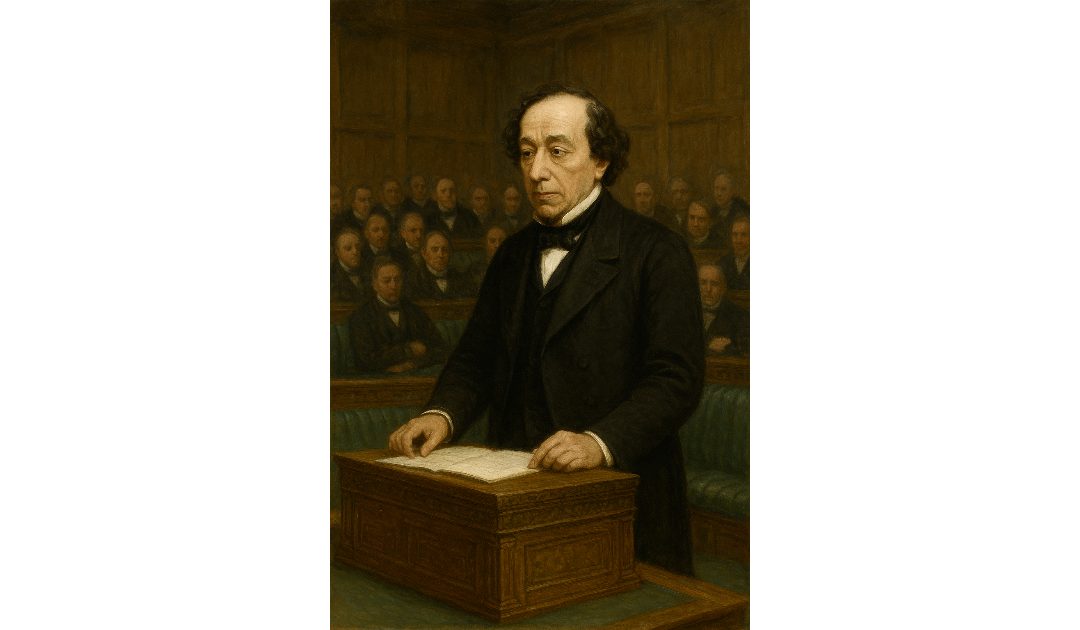
I have made my selection for today’s post from the birthday section. Benjamin Disraeli (1804–1881) was one of the most influential figures in 19th-century British politics, celebrated both for his literary talents and his role as a two-time Prime Minister. He remains a central figure in the history of the Conservative Party (well they have a history, there’s a question mark over their future at the moment), remembered for his wit, charisma, and the distinctive way he blended political pragmatism with a grand vision of Britain’s place in the world.
Born on the 21st of December, 1804, in London, Disraeli was the son of Isaac D’Israeli, a man of letters from a Sephardic Jewish family. His father converted to Anglicanism when Benjamin was twelve, which allowed him to pursue a political career during a period when Jewish individuals were largely excluded from Parliament. Disraeli’s early life was marked by literary ambition: before he became a major political figure, he gained fame as a novelist. His works, such as Vivian Grey (1826) and later Sybil (1845), often revealed his views on society, politics, and the division between the rich and the poor. Sybil, in particular, highlighted the plight of the working classes and introduced the concept of “two nations” – the rich and the poor – a theme that would influence his political outlook.
Disraeli first entered Parliament in 1837 as the MP for Maidstone, having failed several times previously to win a seat. He initially faced ridicule, in part due to his flamboyant dress and manner, but his rhetorical talent and determination soon silenced critics. He became a leading figure among the Conservatives who opposed the dominance of Sir Robert Peel. When Peel repealed the Corn Laws in 1846, splitting the Conservative Party, Disraeli emerged as a principal voice for the protectionist faction, aligning himself with Lord Derby. Over the next decades, he became the intellectual and strategic force behind the rebuilding of the Conservative Party.
Disraeli’s first term as Prime Minister came in 1868, after Lord Derby’s resignation. However, this tenure was short-lived, as the Conservatives lacked a Parliamentary majority and were soon defeated in the general election by William Gladstone’s Liberals. His second term, from 1874 to 1880, proved far more significant. During this period, Disraeli enacted a series of domestic and foreign policies that left a lasting mark on British history.
On the domestic front, Disraeli promoted what he called “One Nation Conservatism,” a philosophy that aimed to bridge the divisions between the upper and working classes. His government passed reforms aimed at improving public health and housing, including the Artisans’ and Labourers’ Dwellings Improvement Act (1875) and the Public Health Act (1875). He also strengthened the Factory Acts, improving conditions for workers. Though some of these measures were modest, they reflected his belief that the Conservative Party should be a national party concerned with the welfare of all citizens, not simply a defender of the landed elite.
Disraeli’s foreign policy was even more dramatic, reflecting his vision of Britain as a global power and the guardian of the Empire. He secured control of shares in the Suez Canal in 1875, ensuring a vital route to India and enhancing Britain’s strategic position. His government’s handling of the Eastern Question, particularly the Russo-Turkish War (1877–1878), culminated in his celebrated appearance at the Congress of Berlin in 1878, where he negotiated a settlement that he claimed preserved peace and strengthened Britain’s influence. His remark that he had brought back “peace with honour” delighted the Queen and his supporters, and it enhanced his international reputation.
Disraeli’s relationship with Queen Victoria was a notable aspect of his political career. Unlike his great rival William Gladstone, whom the Queen often found tiresome, Disraeli flattered and entertained her, earning her favour and trust. He was eventually made Earl of Beaconsfield in 1876, entering the House of Lords while continuing to direct policy and lead his party.
Despite his achievements, Disraeli’s political fortunes were not unbroken. His government was defeated in 1880, largely over domestic discontent and foreign policy controversies, paving the way for Gladstone’s return. Disraeli retired from active politics but remained a towering figure until his death on the 19th of April, 1881.
Benjamin Disraeli’s legacy is multifaceted. He was a pioneering figure in shaping modern Conservatism, promoting an approach that married traditional institutions with social reform. His literary contributions enriched political discourse, and his foreign policy reinforced Britain’s image as a global power. Above all, he was a master of political theatre and strategy, remembered for his wit, eloquence, and ability to navigate the complex currents of Victorian society.