
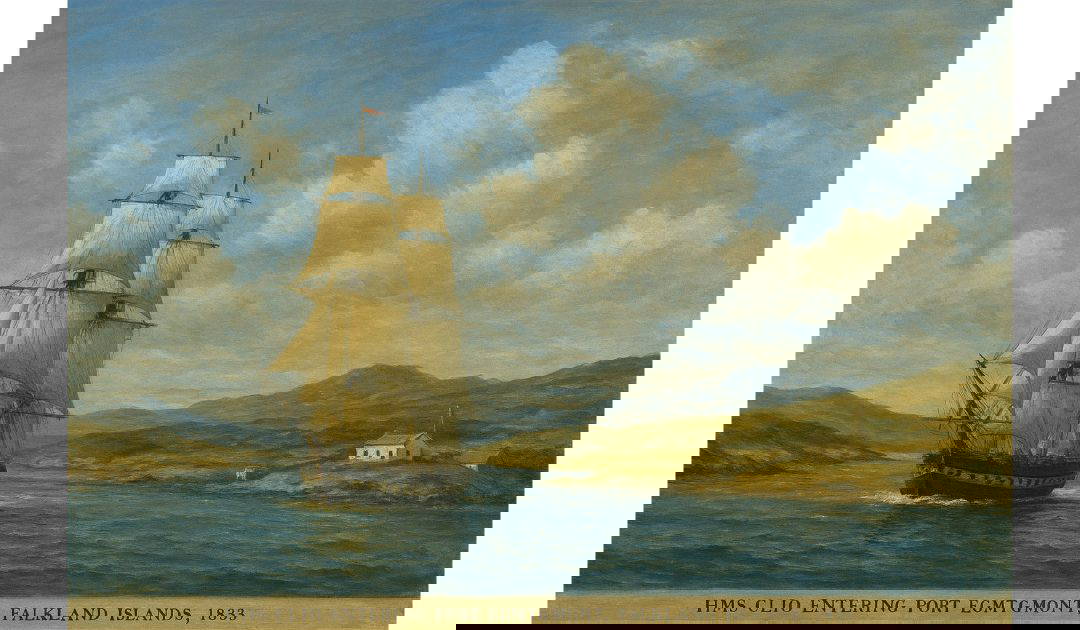
I have posted about the Falkland Islands before. I watched the Falklands Conflict of 1982 played out on the news, whilst studying at Oxford. I served in the Royal Naval Reserve with men who had served in that conflict. Claire and I visited the Falkland Isles in 2019. So let’s dive deeper into the history of those islands.
On the 20th of December, 1832, HMS Clio under the command of Captain Onslow entered Port Egmont. Onslow’s orders were to take possession of the Falkland Islands.
To understand Captain Onslow’s role, one must first consider the geopolitical context. The Falkland Islands, a remote archipelago about 300 miles east of the Patagonian coast, had long been a point of interest for European powers due to their strategic location as a resupply station for ships rounding Cape Horn, as well as a base for whaling and sealing operations. The British had first claimed the islands in 1765, establishing a settlement at Port Egmont, although the Spanish also laid claim to the territory, operating from Puerto Soledad. By the turn of the nineteenth century, both Britain and Spain had withdrawn their permanent garrisons, though Britain never renounced its claim and left a plaque asserting sovereignty.
In 1820, the newly independent United Provinces of the Río de la Plata sought to extend their influence in the South Atlantic. Colonel David Jewett, an American serving their cause, raised their flag over the islands, although his presence was brief. Subsequently, in 1828, Luis Vernet, a merchant of Hamburg origin who had become a citizen of the United Provinces, established a settlement at Puerto Soledad (renamed Puerto Luis), receiving from the Argentine authorities a grant of land and rights to exploit the lucrative sealing industry. Vernet attempted to enforce exclusive rights, seizing American and British vessels accused of illegal sealing. This provoked tensions, and in 1831 the United States warship USS Lexington raided Vernet’s settlement, dismantling its defences and declaring it free to all nations.
It was in this context of instability and competing claims that Britain decided to reassert its authority. The Foreign Office, informed of the Lexington raid and concerned about the disorder, instructed the Royal Navy to investigate. Captain John James Onslow, commanding HMS Clio, was dispatched to carry out this task. Onslow arrived at Port Louis (formerly Puerto Soledad) in early January 1833. By that time, the settlement was sparsely populated and leaderless, as Vernet had left for the mainland to seek support after the American raid.
Captain Onslow’s actions were firm yet measured. He confronted the small Argentine garrison under the command of Major José María Pinedo, who had arrived to maintain a nominal presence. Onslow informed Pinedo that Britain was resuming possession of the islands, citing prior British claims and the need to maintain order. Facing a superior naval force and lacking the will to resist, Pinedo and his men departed aboard the schooner Sarandí, leaving behind the civilian population, who were assured they could remain under British protection.
On the 3rd of January 1833, the Union Flag was raised over the settlement, marking the formal restoration of British administration after a gap of several decades. Onslow left a small garrison and departed, satisfied that the islands were once again under British control. This act was not a violent conquest but rather a diplomatic and naval operation that capitalised on the weakened state of the Argentine claim and the disarray left by the Lexington raid.
The significance of Captain Onslow’s repossession lay in its long-term consequences. From that moment, Britain maintained an unbroken presence in the Falkland Islands, developing them as a coaling station, a refuge for whalers, and later a pastoral settlement based on sheep farming. Although Argentina has continued to dispute the sovereignty of the islands to this day, Onslow’s mission in 1833 effectively secured Britain’s position for the remainder of the nineteenth century and beyond.
In retrospect, Onslow’s undertaking exemplified the understated manner in which the British Empire often expanded its influence—through a combination of naval presence, diplomatic assertion, and the opportunistic filling of power vacuums. His repossession of the Falklands in 1833 (which some contemporaries referred to in the context of the 1832-33 sequence of events) was a decisive moment in the islands’ history, setting the stage for nearly two centuries of British administration.