
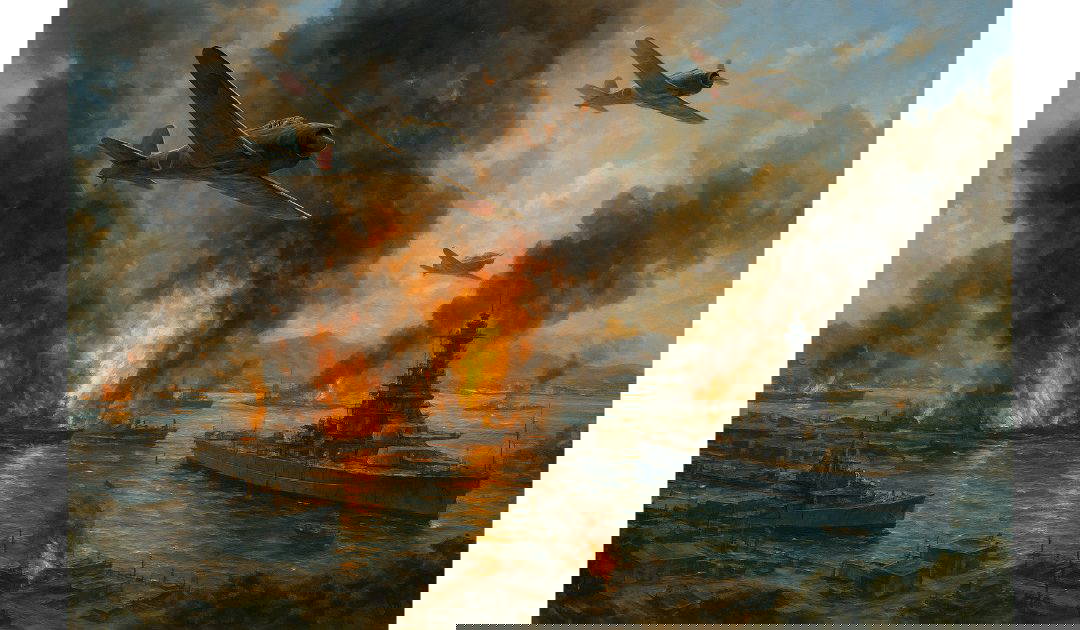
It grieves me to spell harbour incorrectly, but it is American, and that’s the way they spell it. The 7th of December, 1941, was the day the Imperial Japanese Navy attacked Pearl Harbor, a date which will live in infamy, as Franklin D. Roosevelt said.
It was also a pivotal event in world history, marking the moment when the United States was drawn into the Second World War. This surprise military strike, executed by the Imperial Japanese Navy Air Service, targeted the United States naval base at Pearl Harbor in Hawaii. It was meticulously planned with the aim of crippling the US Pacific Fleet, thereby preventing American interference in Japan’s ambitions to dominate the Asia-Pacific region.
The origins of the attack were rooted in the tense geopolitical climate of the 1930s. Japan, having expanded aggressively into China and other parts of Asia, faced increasing opposition from Western powers. The United States, in particular, disapproved of Japan’s invasion of China and subsequent actions in French Indochina. In an effort to curb Japanese expansion, the US imposed severe economic sanctions, including an oil embargo in 1941. As Japan relied heavily on imported oil, this threatened its military capabilities and industrial output. Confronted with this pressure, Japanese leaders concluded that striking decisively at the United States could secure their dominance in the Pacific, buying time for further conquests.
The plan to attack Pearl Harbor was conceived under the leadership of Admiral Isoroku Yamamoto, who was well aware of the risk of provoking a much larger conflict with the United States. The strategy hinged on delivering a sudden, overwhelming blow to the American fleet, particularly its battleships and aircraft carriers, to neutralise US naval power and demoralise the nation. The operation was carefully prepared over months, with the attacking force consisting of six aircraft carriers, over 350 aircraft, and a number of submarines. The task force sailed in secrecy across the northern Pacific, taking a circuitous route to avoid detection.
At approximately 7:48 a.m. on that Sunday morning, the first wave of Japanese aircraft descended upon Pearl Harbor. The attack began with torpedo bombers and dive bombers targeting battleships moored along Battleship Row, while fighters strafed airfields to prevent US aircraft from taking off. Within minutes, ships were ablaze, and chaos spread across the harbour. The second wave followed shortly after, hitting additional ships and facilities. By the end of the attack, eight US battleships had been damaged, with four sunk, including the USS Arizona, which suffered a catastrophic explosion and became the final resting place for over a thousand sailors. Numerous cruisers, destroyers, and nearly 200 aircraft were also destroyed or damaged.
The human cost of the attack was harrowing. More than 2,400 Americans were killed, and over 1,100 wounded. The majority were military personnel, though civilians were also among the casualties. Japanese losses were comparatively light, with fewer than 100 personnel killed and only a handful of aircraft and submarines lost. Despite the scale of destruction, key elements of the US fleet were spared. Crucially, none of the aircraft carriers were present in the harbour at the time, a factor that would later enable the US Navy to recover and retaliate.
The immediate aftermath of the attack was one of shock and outrage across the United States. President Franklin D. Roosevelt addressed Congress the following day, delivering his now-famous “Day of Infamy” speech. He called for a declaration of war against Japan, which was swiftly approved, bringing the United States fully into the Second World War. Within days, Germany and Italy, as Japan’s Axis partners, declared war on the US, sealing the global nature of the conflict.
Strategically, the Japanese attack achieved a short-term success but failed in its ultimate objectives. While it inflicted heavy damage and temporarily weakened the US Pacific Fleet, it did not destroy American aircraft carriers or vital repair and fuel facilities, which allowed a rapid recovery, and a decisive victory in the Battle of Midway, six months later. Moreover, rather than intimidating the United States into submission, the attack galvanised American public opinion and unified the nation behind the war effort. The industrial and military might of the United States was swiftly mobilised, leading to a protracted Pacific War that would ultimately result in Japan’s defeat.