
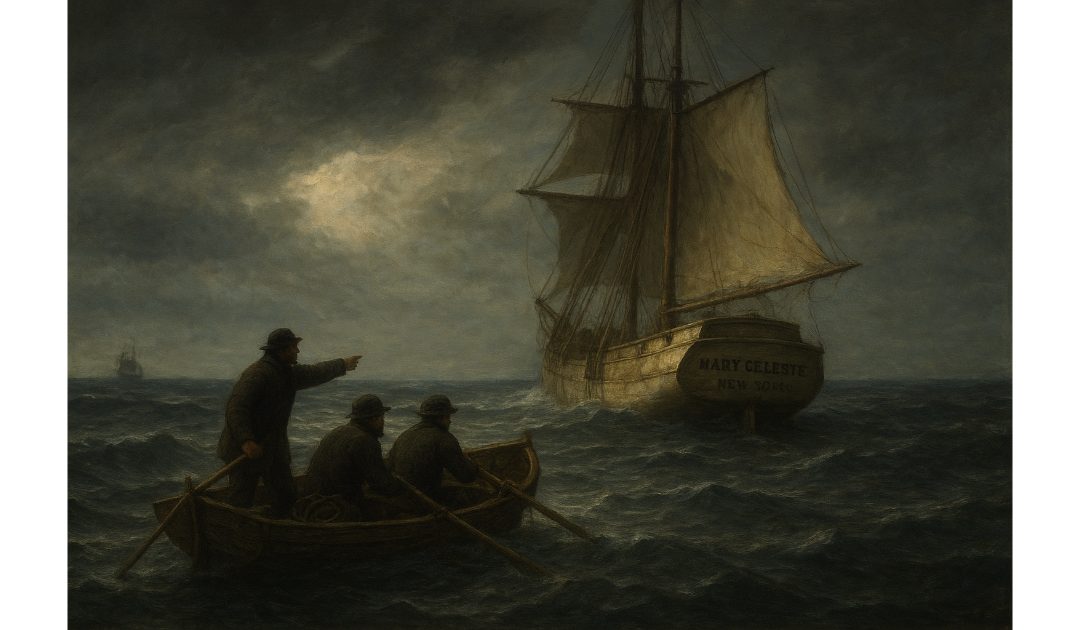
On the 4th of December, 1872, the American brigantine Mary Celeste was found drifting in the Atlantic. She had departed New York Harbour on the 7th of November, bound for Genoa, Italy. She was carrying a cargo of 1,701 barrels of industrial alcohol. Her captain was Benjamin Spooner Briggs, an experienced and respected seaman, who was travelling with his wife Sarah and their two-year-old daughter Sophia. There were also seven crew members aboard, making for a total of ten souls.
Less than a month later, the British brig Dei Gratia, commanded by Captain David Morehouse, sighted the Mary Celeste adrift in the Atlantic Ocean, about 400 miles east of the Azores. To the astonishment of the Dei Gratia’s crew, the ship appeared deserted. A boarding party discovered that the Mary Celeste was largely seaworthy, with only minor damage to her rigging and some water in the bilge. Her sails were somewhat tattered, and a single lifeboat was missing, but otherwise the vessel was in fair condition.
The ship’s cargo was mostly intact, though a few barrels had leaked. The crew’s personal belongings, provisions, and supplies were still on board, and there was no sign of any violent struggle or piracy. The ship’s logbook gave no indication of looming disaster. It recorded routine entries up until the 25th of November, when the ship was near the Azores. From that point onward, the fate of her crew remains a matter of speculation.
Theories about the disappearance of the Mary Celeste’s crew have flourished for over a century. The most mundane explanation is that the crew abandoned ship believing she was sinking or in imminent danger. Some speculate that the vessel may have taken on water during rough seas, and that the captain ordered everyone into the lifeboat as a precaution, only for them to be lost at sea. Others believe that the industrial alcohol in her hold might have leaked fumes, creating the fear of an explosion, prompting a hasty evacuation.
More sensational theories have suggested pirate attacks, mutiny, or even supernatural involvement, although there is no evidence to support these ideas. Over time, the legend of the Mary Celeste has been embroidered with fictional details, in part due to Sir Arthur Conan Doyle’s 1884 short story “J. Habakuk Jephson’s Statement,” which popularised the tale. His fictionalised account introduced elements of mystery and menace that contributed to the ship’s reputation as a ghostly enigma.
After her discovery, the Mary Celeste was sailed to Gibraltar by the Dei Gratia’s crew, where an official inquiry was held. The salvage hearing examined the possibility of foul play, but ultimately found no conclusive evidence of wrongdoing. The Dei Gratia’s crew was awarded a reduced salvage payment, as the authorities seemed suspicious of the circumstances, though no charges were ever brought.
The ship itself continued to sail for another twelve years, passing through several owners, before meeting her end in 1885. Her final owner deliberately wrecked her off the coast of Haiti in an attempted insurance fraud. This ignoble conclusion did nothing to diminish her legend, already immortalised as one of the sea’s great mysteries.