
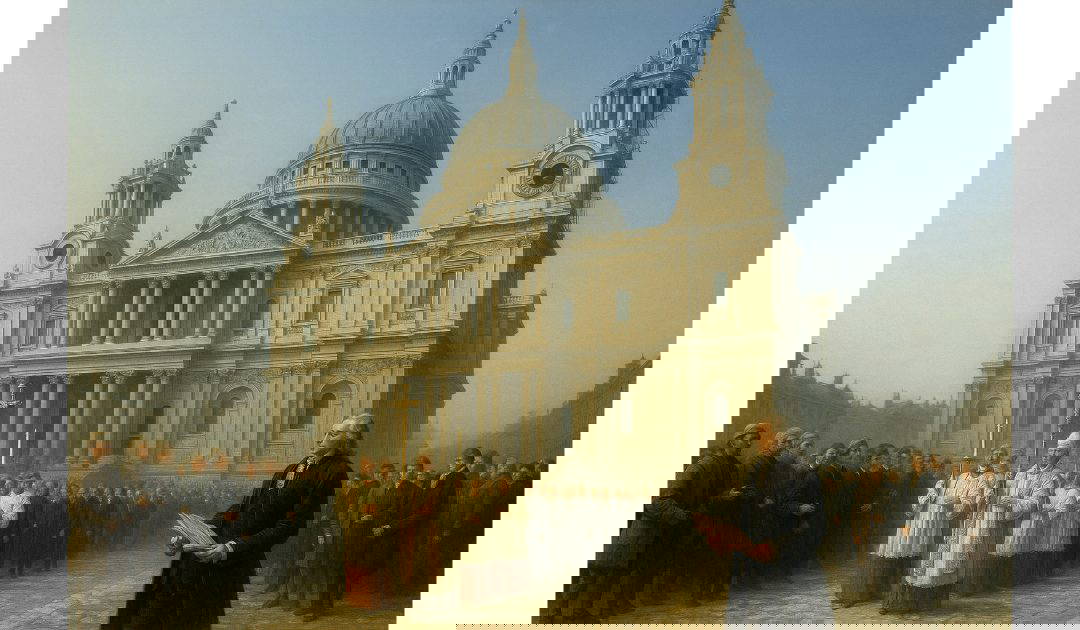
On the 2nd of December, 1697, Saint Paul’s Cathedral, rebuilt to Sir Christopher Wren’s design after the Great Fire of London, was consecrated.
Sir Christopher Wren (1632–1723) was one of the most influential architects in British history, renowned for his role in shaping the city of London after the Great Fire of 1666 and for his enduring contributions to the fields of science, mathematics, and architecture. His life and work spanned a remarkable period of intellectual and political change, from the turmoil of the English Civil War to the dawn of the Georgian era, and he is remembered as a figure of ingenuity, discipline, and vision.
Born on the 20th of October, 1632, in East Knoyle, Wiltshire, Wren was the son of Christopher Wren Sr., the Dean of Windsor. He was a precocious child, showing early talent in mechanics and geometry. His education began at Westminster School and continued at Wadham College, Oxford, where he immersed himself in the vigorous scientific community of the time. He became a founding member of the Royal Society and was esteemed as a gifted mathematician and natural philosopher, with interests ranging from astronomy and optics to anatomy and engineering.
Before he gained fame as an architect, Wren’s early career was dedicated to science. He held academic posts, including the Savilian Professorship of Astronomy at Oxford, and he conducted experiments and observations that aligned him with the great thinkers of the Scientific Revolution, such as Robert Hooke and Isaac Newton. His scientific work informed his later architectural designs, as he approached structures with a precise understanding of geometry, forces, and materials.
Wren’s transition into architecture occurred in the 1660s, influenced by continental styles he encountered during visits to Paris. He studied the Baroque architecture of France and Italy, including the works of François Mansart and Gian Lorenzo Bernini, which inspired his own synthesis of classical and modern forms. His first major commission was the Sheldonian Theatre in Oxford (completed in 1669), a building that combined elegance with ingenious engineering, notably its unsupported roof structure.
The defining moment of Wren’s architectural career came after the Great Fire of London in 1666. As Surveyor-General of the King’s Works, he was tasked with rebuilding much of the city, which had been devastated by the disaster. His grand plan to redesign London with broad boulevards and public squares was ultimately rejected, but he left an indelible mark through the reconstruction of churches, civic buildings, and, most famously, St Paul’s Cathedral.
St Paul’s Cathedral (1675–1710) stands as Wren’s masterpiece and one of the most celebrated buildings in Britain. The cathedral’s majestic dome, inspired by Michelangelo’s St Peter’s Basilica in Rome, became a symbol of the city and a triumph of engineering. Wren’s design balanced classical proportions with Baroque grandeur, and he oversaw its construction for more than three decades, adapting and refining his plans as the work progressed. The completion of St Paul’s cemented his legacy as the leading architect of his age.
In addition to St Paul’s, Wren was responsible for designing or rebuilding over 50 churches in London, including St Mary-le-Bow, St Bride’s, and St Stephen Walbrook. His post-Fire churches display a remarkable variety of spires, towers, and interiors, reflecting his adaptability and creative vision. Beyond ecclesiastical architecture, he also contributed to secular projects, such as the Royal Hospital Chelsea, parts of Hampton Court Palace, and the Greenwich Observatory.
Though primarily remembered as an architect, Wren remained a man of science throughout his life. His works reveal a constant interplay between structural innovation and aesthetic elegance, merging the intellectual rigour of a mathematician with the imagination of an artist. He received a knighthood in 1673 and continued to serve the Crown under successive monarchs, navigating periods of political change with characteristic discretion.
Sir Christopher Wren lived to the age of 90, a remarkable longevity for his era. He died on the 25th of February, 1723, and was buried in the crypt of St Paul’s Cathedral. His epitaph, composed by his son, famously reads, “Lector, si monumentum requiris, circumspice” – “Reader, if you seek his monument, look around you.” This statement captures the essence of his life’s work, for Wren’s legacy is quite literally built into the fabric of London.
Wren is celebrated not only as the architect of St Paul’s but as a figure who embodied the spirit of the Enlightenment in England. His blend of scientific acumen, artistic sensibility, and civic vision left a lasting imprint, and his buildings continue to inspire admiration for their harmony, ingenuity, and timeless beauty.