
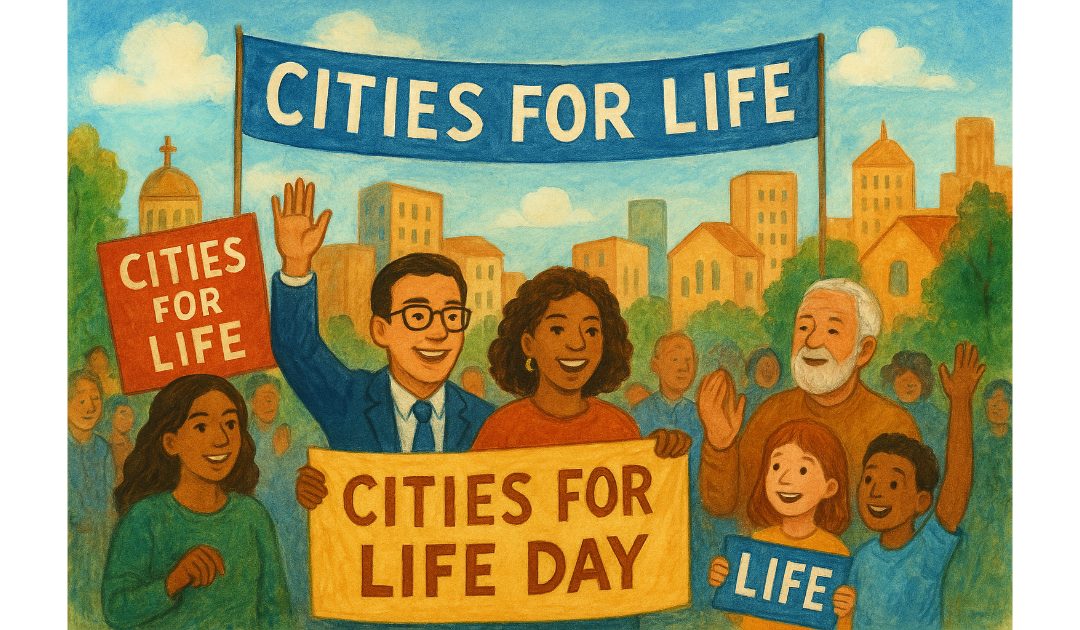
The 30th of November Is celebrated as “Cities for Life Day”. It began in 1786 on the day that the Grand Duchy of Tuscany, under Pietro Leopoldo, became the first civil state in the world to do away with torture and capital punishment.
I confess that I had not known about this before now, despite my interest in the Medici family. My ancestor, the Elizabethan spy, Sir Anthony Standen, was sent by Francis Walsingham to spy on Francesco I, Grand Duke of Tuscany, who Walsingham suspected of aiding Mary Queen of Scots. I have written Standen’s story in The Spy who Sank the Armada.
The Grand Duchy of Tuscany, a prominent state in central Italy, existed from 1569 to 1859 and played a significant role in the political, cultural, and economic landscape of the Italian peninsula. Its history is deeply intertwined with the illustrious Medici family, whose influence shaped Tuscany’s transformation from a collection of medieval communes to a centralised and cultured duchy.
The roots of the Grand Duchy lie in the Republic of Florence, a wealthy and vibrant city-state that gained prominence during the Renaissance. By the 16th century, the Medici family, who had risen to power as bankers and patrons of the arts, consolidated their control over Florence. In 1532, Pope Clement VII, himself a Medici, established the hereditary Duchy of Florence for Alessandro de’ Medici. This marked the beginning of the Medici’s formal ducal rule, which laid the groundwork for the Grand Duchy.
In 1569, Cosimo I de’ Medici, having successfully expanded Florentine influence over neighbouring territories such as Siena, was granted the title of Grand Duke of Tuscany by Pope Pius V. This elevated status signified the Medici’s pre-eminence in Italy and the consolidation of Tuscany as a unified state. Cosimo I focused on fortifying coastal towns, improving agriculture, and fostering trade, while also patronising the arts and sciences, continuing Florence’s proud Renaissance heritage.
Under subsequent Medici rulers, the Grand Duchy enjoyed periods of stability and cultural brilliance. The Medici were great supporters of intellectual pursuits, sponsoring works in architecture, painting, and science. Figures such as Galileo Galilei thrived under their patronage. Economically, however, Tuscany faced challenges, as its once-thriving textile industry declined, and new trade routes diminished its commercial significance.
The Medici line ended in 1737 with the death of Gian Gastone de’ Medici, leaving no direct heirs. By the provisions of European diplomacy, the Grand Duchy passed to Francis Stephen of Lorraine, husband of Empress Maria Theresa of Austria, thus initiating the rule of the House of Habsburg-Lorraine. This dynastic shift tied Tuscany more closely to Austria’s sphere of influence.
Under Habsburg-Lorraine governance, beginning with Francis I and later his son Pietro Leopoldo (Leopold II, Holy Roman Emperor), the Grand Duchy entered a period of enlightened reform. Pietro Leopoldo, ruling from 1765 to 1790, introduced progressive policies, including agricultural modernisation, judicial reform, and, as I began, the abolition of the death penalty in 1786—making Tuscany one of the first states to do so.
The Napoleonic Wars profoundly disrupted Tuscany. In 1801, Napoleon forced the abdication of the Habsburg-Lorraine Grand Duke Ferdinand III, creating the short-lived Kingdom of Etruria. French administration followed, and Tuscany was annexed to the French Empire from 1808 until Napoleon’s defeat in 1814, after which Ferdinand III was restored.
The final decades of the Grand Duchy saw increasing pressures from the Risorgimento, the movement for Italian unification. Leopold II, who had succeeded Ferdinand III, eventually faced revolutionary turmoil, and in 1859, amidst the Second Italian War of Independence, the Grand Duchy was overthrown. Tuscany was annexed to the Kingdom of Sardinia, which soon became the unified Kingdom of Italy in 1861, marking the end of the Grand Duchy’s nearly three centuries of history.
The Cities for Life initiative, which originated in Tuscany, has inspired numerous other cities and countries to embrace the movement against the death penalty. Following Tuscany’s lead, cities across Italy—such as Rome, Florence, and Milan—became early adopters, lighting up prominent landmarks on the 30th of November each year to symbolise commitment to life and human dignity. The movement then spread across Europe, with Paris, Madrid, and Brussels joining the campaign, reflecting a strong continental stance on human rights.
Beyond Europe, several cities in the Americas and Asia have also participated. In North America, cities including Montreal, Mexico City, and San Francisco have aligned with the Cities for Life values, promoting awareness and legislative advocacy. In Latin America, Bogotá and Buenos Aires have followed suit, hosting educational events alongside the symbolic illumination of public spaces. In Asia, key cities like Manila and Seoul have joined the initiative, demonstrating a growing global consensus against capital punishment.
Countries such as France, Spain, and Belgium have integrated the Cities for Life philosophy into broader national campaigns for the abolition of the death penalty. This international network now encompasses over 2,000 cities worldwide, all inspired by Tuscany’s pioneering stance in championing life over execution.