

Service
I’m currently waiting for our Aga to be serviced. So I’ve picked service as my word of the day. The word service has a long and fascinating history, beginning in the Roman world and evolving through medieval feudalism to acquire its many modern meanings. Its ultimate...
Storm
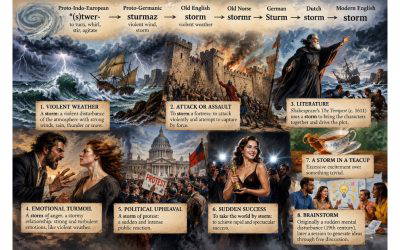
As I write the UK is being buffeted by Storm Austen, and tomorrow we are expecting Storm Boelo. So as part of my word of the day series let’s have a look at the word storm. Storm is one of the oldest words in the English language, with roots stretching back thousands...

Stymie
In yesterday’s post I said that the Oxford University Golf Second Team was called the Divots. Our Cambridge opponents were the Stymies. To be stymied is to be obstructed, frustrated or prevented from achieving an objective. A politician may be stymied by parliamentary...

Divot
When I was at Oxford I played golf for the university second team, which is called the Divots. The word divot is familiar to golfers everywhere, describing the piece of turf dislodged when a club strikes the ground. Yet its origins have nothing to do with golf. The...

Read
2026 is the the UK National Year of Reading. Sadly across the world just 45% of ten-year-olds say that they read for pleasure. And if you think that the UK is an advanced country, that figure is just 29% in the UK. Perhaps the Sir Anthony Standen Adventures might...

Oil
The word oil has a history stretching back more than three thousand years, beginning with one of the Mediterranean’s most important agricultural products: the olive. Our English word derives from the Old French oile or uile, which came from the Latin oleum, meaning...

Paranoid
The word paranoid comes from the Greek paranoia (παράνοια) meaning mental derangement, madness, or folly. I’m keeping my fingers crossed for an upswing in sanity at the US mid-terms. This was formed from two elements: para (παρά), meaning “beside”, “beyond” or...

Sanction
The only difficulty I have with my word of the day series is choosing the word. So today I checked the news and saw that Trump has lifted sanctions on Russia that he had only just imposed. The word sanction is a fascinating example of a word that has developed two...
What Does Mean Mean?
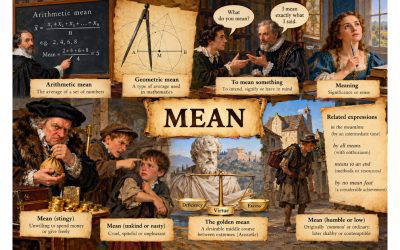
Few words in the English language work quite as hard as mean. We use it to describe an average, an intention, a miserly disposition, a mathematical calculation, and even something nasty or unpleasant. Remarkably, these meanings arise from three distinct linguistic...
Service
I’m currently waiting for our Aga to be serviced. So I’ve picked service as my word of the day. The word service has a long and fascinating history, beginning in the Roman world and evolving through medieval feudalism to acquire its many modern meanings. Its ultimate...
Storm
As I write the UK is being buffeted by Storm Austen, and tomorrow we are expecting Storm Boelo. So as part of my word of the day series let’s have a look at the word storm. Storm is one of the oldest words in the English language, with roots stretching back thousands...
Stymie
In yesterday’s post I said that the Oxford University Golf Second Team was called the Divots. Our Cambridge opponents were the Stymies. To be stymied is to be obstructed, frustrated or prevented from achieving an objective. A politician may be stymied by parliamentary...
Divot
When I was at Oxford I played golf for the university second team, which is called the Divots. The word divot is familiar to golfers everywhere, describing the piece of turf dislodged when a club strikes the ground. Yet its origins have nothing to do with golf. The...
Read
2026 is the the UK National Year of Reading. Sadly across the world just 45% of ten-year-olds say that they read for pleasure. And if you think that the UK is an advanced country, that figure is just 29% in the UK. Perhaps the Sir Anthony Standen Adventures might...
Oil
The word oil has a history stretching back more than three thousand years, beginning with one of the Mediterranean’s most important agricultural products: the olive. Our English word derives from the Old French oile or uile, which came from the Latin oleum, meaning...
Paranoid
The word paranoid comes from the Greek paranoia (παράνοια) meaning mental derangement, madness, or folly. I’m keeping my fingers crossed for an upswing in sanity at the US mid-terms. This was formed from two elements: para (παρά), meaning “beside”, “beyond” or...
Sanction
The only difficulty I have with my word of the day series is choosing the word. So today I checked the news and saw that Trump has lifted sanctions on Russia that he had only just imposed. The word sanction is a fascinating example of a word that has developed two...
What Does Mean Mean?
Few words in the English language work quite as hard as mean. We use it to describe an average, an intention, a miserly disposition, a mathematical calculation, and even something nasty or unpleasant. Remarkably, these meanings arise from three distinct linguistic...