
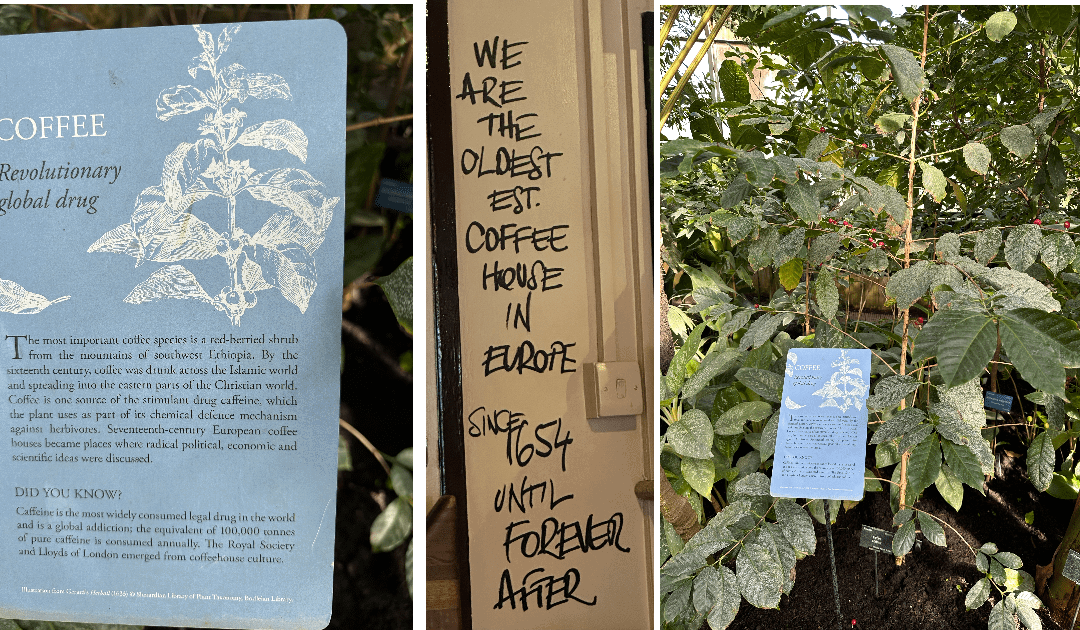
What is this revolutionary global drug? I wrote recently about our visit to Oxford and the botanic garden. We also enjoyed a coffee in the Queen’s Lane Coffee House, which is reputed to be the longest established coffee house in Europe. Established in 1654 is written on their wall.
An information board in the botanic garden informed us that the most important coffee species is a red-berried shrub from the mountains of southwest Ethiopia. It told us that by the sixteenth century coffee was being drunk across the Islamic world, and spreading into the eastern parts of the Christian world. The story is holding together so far. It also told us that seventeenth century European coffee houses became places where radical political, economic, and scientific ideas were discussed.
I remembered that Lloyds of London owes its name to its beginnings in the Lloyds Coffee House which opened in London in 1686. Further research on Wikipedia made clear the role that coffee houses played. It was far easier to discuss important ideas under the stimulus of caffeine, than in an ale house. The board in the botanic garden states that caffeine is the most widely consumed legal drug in the world. Around 100,000 tonnes of pure caffeine is consumed every year.
So the Queen’s Lane Coffee House opened thirty-two years before Lloyds. When I was researching the last post, I found an interesting article in the Oxford Mail. The Mail tells us that Jacob, a Jew from Lebanon, opened a coffee house in Oxford in 1651. So Queens Lane wasn’t the first coffee house in Oxford, let alone Europe. Therefore it’s claim is that it is the longest established, still operating coffee house.
I wondered if tea might have arrived earlier, but according to the BBC, tea arrived in England to be served as a novelty in London’s coffee houses, albeit soon after the coffee houses opened. I’m afraid Sir Anthony Standen will have to continue drinking wine and ale for the foreseeable future. The revolutionary global drug is yet to arrive.